Traditional vs AI-powered legal marketing strategies like predictive scoring may help law firms lower their cost per signed medical-malpractice case - but this hypothetical study does not prove it. Its sample baseline shows $40,000 in ad spending and 8 signed retainers: $5,000 per signed case , a common challenge for firms facing low client leads, with no collected-fee data to establish realized ROI.
The study outlines how a firm could test scoring by linking intake, marketing, case, and accounting records. It covers how to:
- Predict qualification and signing using only information available at each stage.
- Test budget and follow-up changes while keeping attorneys in charge of case decisions.
- Protect client data and check model errors, bias, and missed viable matters.
- Compare cohorts with equal follow-up periods and separate projected fees from collected revenue.
The rule is simple: more signed retainers do not, by themselves, prove better ROI. That requires verified collections, consistent cost tracking, and enough time for cases to resolve.
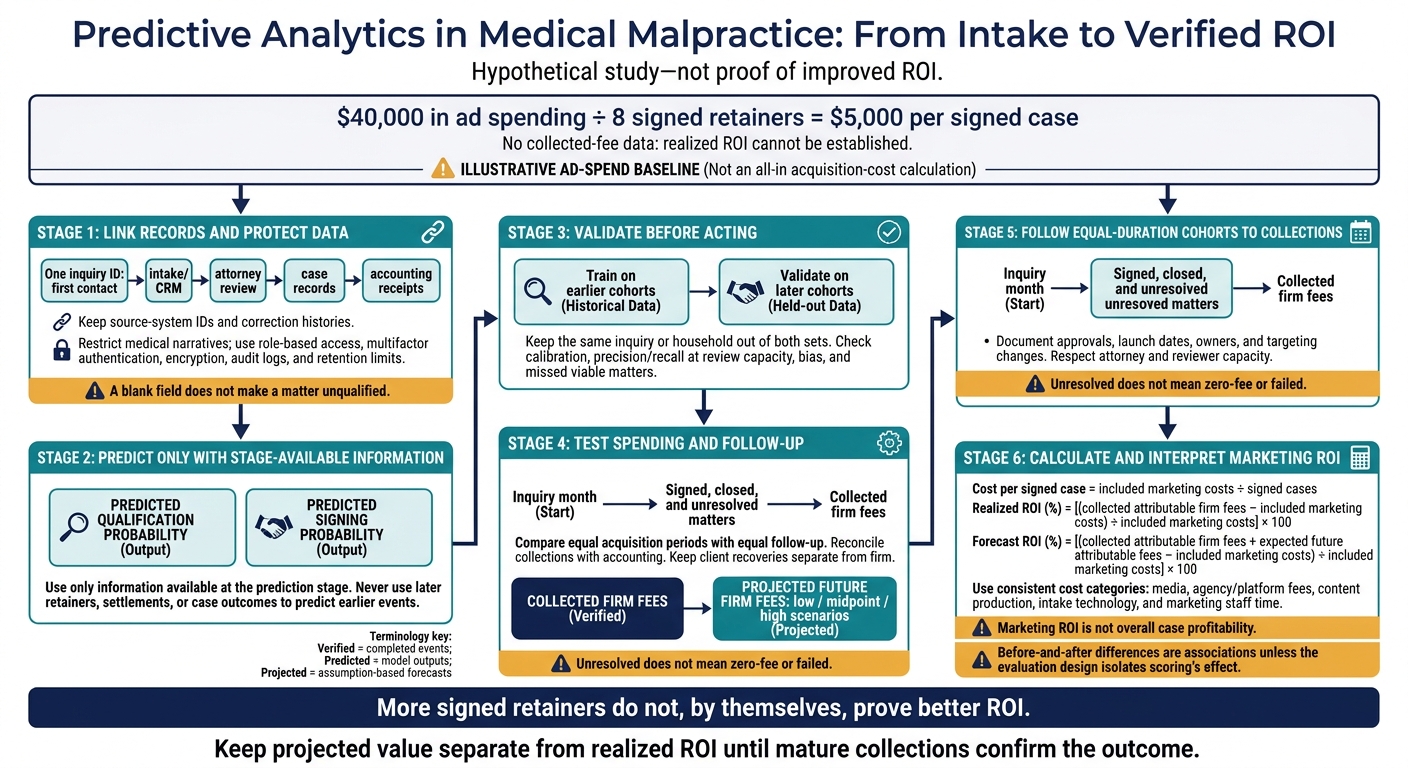
Predictive Analytics in Medical Malpractice: From Intake to Verified ROI
2. Data Sources and Prediction Methods
Record Linking and Data Protection
Assign one inquiry ID at first contact and use it across web forms, calls, chat, referrals, CRM stages, conflict checks, consultations, retainer decisions, and case-management records. That shared ID connects later fee results to the original spend.
Store campaign data, source, timestamp, jurisdiction, claim category, and contact method separately from medical narratives. Start with deterministic matching, such as a verified phone number or email. Use probabilistic matching based on name, ZIP code, and timing only after that. When one person submits multiple inquiries, maintain an ID mapping. Keep source-system IDs so records can be audited.
For each correction, retain the original value, corrected value, correction date, and correction source. Track inquiries, individual potential clients, signed cases, declined matters, and pending records as separate categories. Label missing data as not asked, not disclosed, or not yet available. A blank field does not make a matter unqualified.
Use only the fields needed for routing, measurement, and approved follow-up. Keep medical narratives in restricted intake or case-management systems. Apply role-based access, multifactor authentication, encryption, audit logs, and retention limits.
Review consent, call-recording rules, attorney confidentiality, and applicable state health-data requirements. Attorney confidentiality requires reasonable efforts to prevent unauthorized disclosure of, or access to, information related to representation. Vendor agreements should cover permitted use, subcontractors, breach reporting, retention, deletion, security controls, and whether vendors may use the data to train their own systems.
Model Inputs, Predictions, and Validation
Once records are linked, limit each model to information available at that stage. Record when each input becomes available.
At inquiry, use reported claim type, jurisdiction, device or channel, referral source, landing-page interaction, contact time, and response latency. After an intake specialist completes screening, add qualification status, statute-of-limitations information, opposing-party information, medical-provider details, and attorney-review status. Do not use later information - a signed retainer, settlement amount, or case result - to predict an earlier stage.
Label completed events verified, model outputs predicted, and assumption-based forecasts projected. Freeze monthly snapshots. Record forecast updates explicitly instead of rewriting historical forecasts.
Model qualification and signing as separate probabilities. For projected acquisition cost, choose one denominator across channels - qualified inquiries or signed cases - and keep it constant. Separate the expected fee conditional on signing from the fee weighted by the probability of signing:
[ P(\text{signed}) \times P(\text{fee outcome} \mid \text{signed}) \times \text{expected fee} ]
Show ranges or cohorts rather than false precision. Do not count unresolved matters as zero-fee cases without analyzing censoring and time-to-resolution. These stage-specific predictions later guide budget allocation and follow-up priority.
Train on earlier cohorts and validate on later ones. Keep the same inquiry or household out of both sets. Compare results with an interpretable baseline, such as the overall signing rate or the signing rate by claim type.
Check calibration, precision or recall at the firm’s review capacity, and missed viable matters - not accuracy alone. Require human review rather than automatic rejection. Where lawful, audit missingness, false negatives, and overrides across relevant groups. NIST recommends documented validation and bias evaluation.
Attribution vs. Predictive Scoring
Attribution explains channel credit. Predictive scoring helps prioritize intake.
| Method | Purpose | Strength | Limitation | Best use |
|---|---|---|---|---|
| First-touch attribution | Credits the first recorded interaction | Identifies sources of initial interest | Ignores later interactions | Awareness reporting |
| Last-touch attribution | Credits the interaction before conversion | Easy to implement | Overlooks earlier influence | Conversion tracking |
| Multi-touch attribution | Distributes credit across recorded interactions | Reflects longer journeys | Depends on tracking and weighting assumptions; does not prove causation | Descriptive channel analysis |
| Predictive scoring | Estimates qualification, signing probability, or expected value | Prioritizes intake attention | Vulnerable to bias, drift, leakage, and poor calibration | Stage-specific forecasts with human oversight |
sbb-itb-7e4986a
3. Marketing Budget and Intake Changes
Budget Allocation by Expected Case Value
Use validated scores to direct spending toward channels with the highest expected collectible fee per reviewed matter.
These allocations are hypothetical until firm records support them. The test is whether higher-scoring matters lead to better realized fees at a lower acquisition cost. Before making changes, record each change’s approval date, launch date, owner, targeting changes, and supporting evidence.
Rank spending by qualification probability, signing probability, expected collectible firm fees, acquisition cost, and variable intake cost - not inquiry volume. Limit increases to what attorneys and medical-record reviewers can handle.
| Channel | Hypothetical prior monthly spend | Proposed monthly spend | Dollar change | Percentage change | Assumption requiring validation |
|---|---|---|---|---|---|
| Paid search | $20,000 | $28,000 | +$8,000 | +40.0% | Higher expected contribution per inquiry; sufficient review capacity |
| Organic medical-malpractice content | $10,000 | $14,000 | +$4,000 | +40.0% | Qualified-inquiry and signed-matter data support expansion |
| Referral relationship activities | $5,000 | $5,000 | $0 | 0.0% | Retain allocation pending outcome and compliance review |
| Directories | $8,000 | $6,000 | −$2,000 | −25.0% | Source-level signed-matter data support a reduction |
| Total | $43,000 | $53,000 | +$10,000 | +23.3% | Proposed budget increase, not merely a reallocation |
For each channel, attach inquiry counts, qualified inquiries, attorney reviews, signed retainers, and cost per signed retainer.
Before spending, review advertising, solicitation, lead-generation, and referral arrangements under applicable state rules. Calling a payment “marketing” does not make it a permitted referral payment; ABA Model Rule 7.2 still applies.
Intake Follow-Up and Attorney Review
Budget changes improve ROI only if intake responds faster and reviews the right matters. Test immediate automated acknowledgment and prompt human outreach. Use response-time benchmarks to set staffing targets - not as proof of ROI.
Track each inquiry from first contact through fee collection, grouped by inquiry month. Measure median and 90th-percentile response times, along with the review backlog. Attorneys keep control of acceptance decisions.
Record the main reasons for declining matters, such as jurisdiction, causation evidence, damages, deadline concerns, conflicts, or capacity. Track unreachable contacts and withdrawals separately. At 30-, 60-, and 90-day reviews, audit overrides and missed viable matters.
Content planning supports demand generation. It does not replace scoring or intake routing.
Where Giupedi AI Legal Marketing Platform May Help
Giupedi AI Legal Marketing Platform can support content planning through client-question analysis, GEO, content tools, and attorney review. These functions are separate from predictive scoring, attribution, CRM tracking, and intake routing.
No record here shows actual use, integrations, leads, retainers, or fees. Attorneys still need to oversee content accuracy, confidentiality, and advertising compliance.
4. Marketing ROI and Forecast Accuracy
Before-and-After Results
Use the budget shifts in Section 3 to check whether higher-scoring matters led to better fee outcomes. No verified firm results were supplied, so treat this as a template - not a measured ROI claim. The test is whether predictive scoring lowered acquisition costs and increased collectible fees per signed case.
Compare acquisition periods of equal length, with the same follow-up duration for each inquiry cohort. A qualified inquiry must meet the firm’s medical-malpractice screening criteria. A consultation means a completed attorney consultation, and a signed case means an executed representation agreement. Apply the same cost categories to both periods: media spend, agency or platform fees, content production costs, AI tools for legal ad campaigns, intake technology, and marketing staff time.
| Metric | Before | After |
|---|---|---|
| Included marketing costs | - | - |
| Signed cases | - | - |
| Collected attributable firm fees | - | - |
| Projected future firm fees | - | - |
Cost per signed case = included marketing costs ÷ signed cases.
Realized ROI = (collected attributable firm fees − included marketing costs) ÷ included marketing costs.
For forecast ROI, add expected future attributable fees to collections, subtract included marketing costs, and divide by included marketing costs.
Report ROI as a percentage. Calculate other percentage changes as (after − before) ÷ before × 100. If the baseline is zero, percentage change is undefined. These figures measure marketing ROI only. Assess legal labor, litigation costs, and overhead in a separate profitability analysis.
Collected and Projected Fees by Cohort
Group inquiries by month. Add claim type and source only when sample sizes support reliable reporting. Record firm fees when the money is collected - not when a retainer is signed - and keep client recoveries separate.
| Monthly-cohort fields | Reporting treatment |
|---|---|
| Inquiry month, inquiry count, claim type, source | Keep the cohort and attribution rule fixed |
| Follow-up duration, signed, closed, and unresolved cases | State the cutoff and unresolved share |
| Collected firm fees | Reconcile with accounting receipts |
| Projected future firm fees and supporting matter count | Show low, midpoint, and high estimates separately from collections |
Document the assumptions behind projected fees: the contingency-fee percentage, jurisdiction-specific fee limits, litigation-cost treatment, expected settlement or verdict timing, probability of successful resolution, collection probability, and payment lag. Explain whether expenses reduce the fee base. Call uncertainty ranges scenarios unless they are statistically calculated intervals, and track unresolved matters separately.
With cohort fees organized, test whether the score predicted those outcomes without using information that became available later.
Forecast Validation and Other Factors
Freeze model outputs before testing them against mature outcomes from held-out or later cohorts. Document the scoring date, evaluation window, sample size, outcome definition, decision threshold, and missing-data rules. Keep unresolved matters visible; don’t count them as failures or quietly remove them.
Treat before-and-after differences as associations, unless the evaluation design separates scoring’s effect from staffing, response speed, seasonality, referral changes, and advertising prices.
| Validation measure | Predicted | Observed | Required comparison |
|---|---|---|---|
| Calibration, by probability band | - | - | Predicted probability versus observed outcome rate; include sample size |
| High-value-case classification | - | - | Precision and recall at the stated threshold |
| Firm fees at a fixed horizon | - | - | Mean and median absolute error; percentage error only with meaningful denominators |
5. Conclusion: Findings and Next Steps
This illustration supports a test-and-verify approach. It does not prove that predictive scoring increases medical-malpractice marketing ROI or brings in more viable cases. Instead, it shows how a firm could test those goals by linking records and tracking outcomes long enough for them to mature.
Study Limits
Small samples, slow case resolution, incomplete attribution, changing ad costs, and uncertain case values limit what a pilot can prove. Results may also differ across firms. The next pilot should focus on cleaner records and allow more time before judging ROI.
Collected-fee ROI cannot yet be measured. Only documented changes in processes or client acquisition should count as findings.
Checklist for a New Pilot
Define the pilot before changing spend to avoid mistaking early gains for success:
- Confirm consistent intake stages, persistent source IDs, linked CRM and matter records, and written revenue and cost assumptions.
- Assign responsibility for privacy controls and vendor agreements, and define eligible jurisdictions.
- Keep model-version records and validate the model on a set schedule. Attorneys should review case suitability and urgent deadlines, with a way to override scores and document those decisions.
- Set fixed pilot dates, a budget ceiling, and stopping rules.
- Define success in advance using attorney-reviewed viable-case rate and cost per signed matter. Use a holdout or matched comparison where feasible.
- Allow enough follow-up time to assess collections. Do not increase spend based on early conversion gains alone.
Keep projected value separate from realized ROI until mature collections confirm the outcome.
FAQs
How much data does my firm need before testing predictive scoring?
Start testing predictive scoring once you’re tracking roughly 30–50 real conversions per month. You need enough conversion data to spot patterns. Account for seasonality and data collection delays before using scores to guide budget decisions.
If conversions are infrequent, use a rolling approach with scenario ranges instead of fitting the model too closely to limited data.
How long should my firm run an ROI pilot?
Run your ROI pilot for 60 to 90 days to set a baseline and track qualified consultations, signed matters, and answered calls.
For new advertising channels, Giupedi AI Legal Marketing Platform recommends testing for at least three months to assess lead quality and acquisition costs before scaling. Content or social media tests may need four to eight weeks. Allow more time if inquiries are infrequent.
How can we tell whether scoring - not faster follow-up - improved results?
Run a controlled test using your firm’s intake and matter records. Start by measuring baseline conversion rates at your current response times and intake capacity.
Keep intake coverage and response times consistent across test groups. Then compare each group’s percentages of inquiries that become consultations and signed matters with the baseline.
Use Giupedi AI Legal Marketing Platform to analyze these metrics while keeping your intake data connected to your case-management system.