AI is reshaping how law firms in the U.S. manage digital advertising. By automating tasks like ad targeting, keyword optimization, and budget adjustments, these tools help firms attract high-value clients while adhering to strict advertising regulations. Key benefits include:
- Real-time Ad Optimization: AI adjusts bids and budgets based on user behavior, location, and other factors to maximize returns.
- Compliance Automation: Tools scan ad copy to ensure it follows state bar and ABA rules, flagging risky language for review.
- Performance Tracking: Advanced analytics link ad spend to signed cases, helping firms measure ROI and refine strategies.
- Creative Testing: AI simplifies A/B testing, identifying the most effective ad copy and landing pages quickly.
- Audience Targeting: Predictive segmentation focuses on high-intent prospects, improving lead quality.
Platforms like Giupedi offer tailored solutions for law firms, integrating features like client acquisition tools, search optimization, and hospital referral systems to streamline operations and boost campaign results. While AI handles much of the heavy lifting, human oversight remains essential for ethical compliance and nuanced decision-making.
3 AI tools that will supercharge your law firm's marketing
What AI Tools Need for Legal Advertising
AI tools designed for legal advertising must adhere to a strict set of rules, including state bar regulations, American Bar Association (ABA) guidelines, and consumer protection laws. These regulations are in place to ensure advertising remains truthful, respects client confidentiality, and upholds ethical standards.
Legal and Ethical Rules
The ABA sets clear boundaries for legal advertising, prohibiting false claims, unsubstantiated comparisons, and breaches of confidentiality. State bar associations, like Florida's, often add stricter rules. For instance, Florida bars language that guarantees outcomes, such as "We guarantee you'll win your personal injury case", or superlatives like "best lawyer" unless they are backed by credible evidence. Similarly, any claims of specialization or certification must include proper disclosures to avoid misleading potential clients.
How AI Helps Meet These Rules
AI tools can play a significant role in ensuring compliance by scanning advertising content in real time to detect misleading phrases and confirm that required disclaimers are included. These tools can also segment audiences, optimize keyword bids, and track performance metrics to improve return on investment (ROI) without crossing ethical boundaries. Advanced AI systems even allow for A/B testing of ad variations, helping identify effective headlines and calls-to-action. Any flagged content that raises compliance concerns is then reviewed to ensure it aligns with state bar requirements.
Why Human Review Is Required
While AI can enhance compliance efforts, human oversight remains critical. AI may struggle to catch subtle language nuances or ethical concerns that could lead to violations. For example, Florida Bar guidelines highlight the importance of human involvement in ensuring marketing strategies avoid misleading claims or breaches of confidentiality. To maintain compliance, it’s best to manually review AI-generated content, conduct regular audits, and verify that all advertising materials meet state bar rules before going live.
Giupedi AI Legal Marketing Platform Features

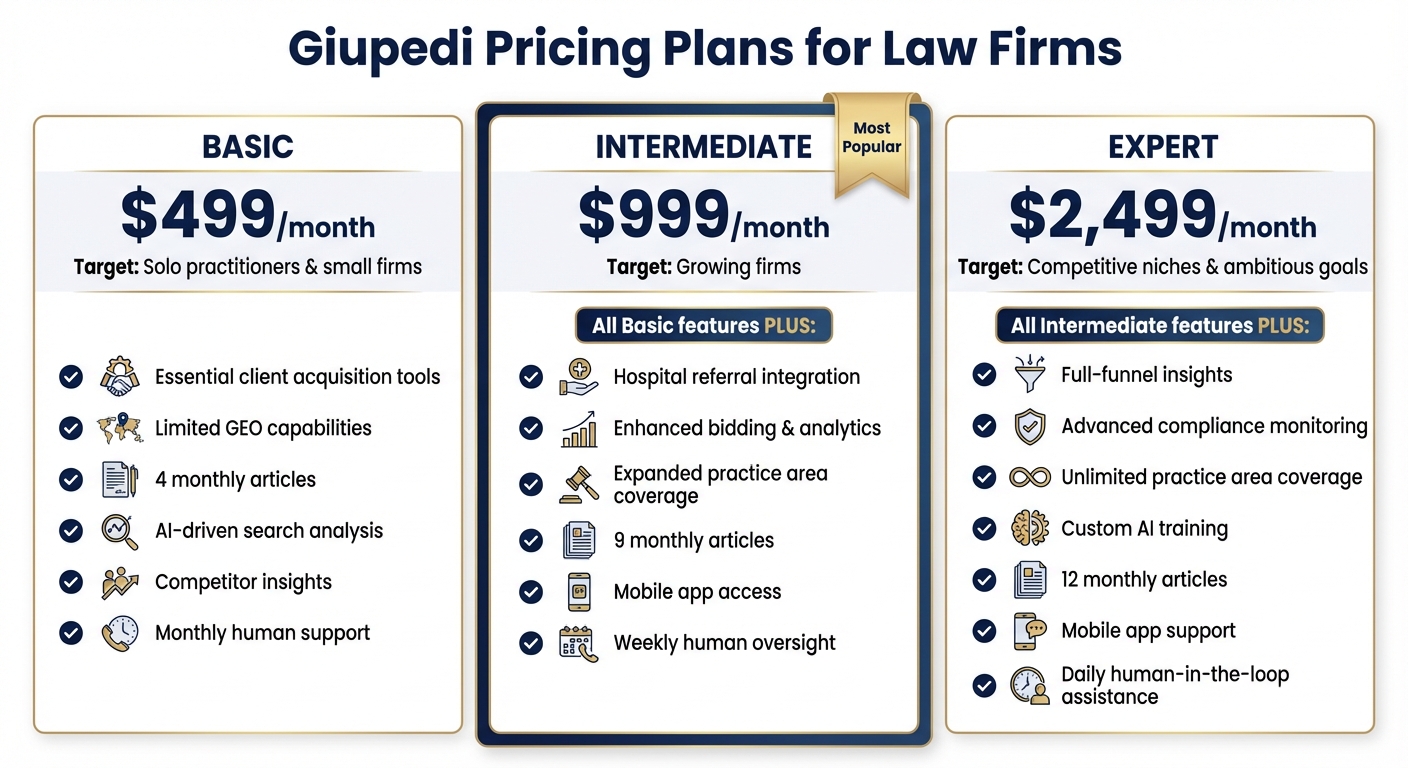
Giupedi AI Legal Marketing Platform Pricing Plans Comparison
Giupedi's AI-driven legal marketing platform offers a range of tools designed specifically for U.S. law firms looking to enhance their online advertising efforts. By combining smart client acquisition, advanced search optimization, and seamless hospital referral systems, the platform helps firms connect with high-intent prospects while ensuring compliance and measurable results. Each feature is crafted to address the unique challenges and performance needs faced by legal professionals.
AI-Powered Legal Client Acquisition
Giupedi's client acquisition tools focus on identifying prospects with a strong intent to seek legal assistance. By analyzing key legal search patterns, the platform deploys targeted ads to reach the right audience at the right time. Additionally, it simplifies the initial intake process with automated workflows, helping law firms engage potential clients efficiently and improve overall conversion rates.
Generative Engine Optimization (GEO)
The Generative Engine Optimization (GEO) feature enhances a law firm's digital visibility across both traditional search engines and newer AI-driven platforms. GEO ensures that a firm's content is optimized for modern search technologies while maintaining consistent branding and messaging. This alignment is crucial for adhering to legal advertising standards and building trust with potential clients.
Hospital Referral Integration
Giupedi's hospital referral integration connects law firms directly with healthcare providers, streamlining injury-related referrals. This feature automates the referral process while ensuring compliance with HIPAA and CCPA regulations. By matching patient data with a firm's specific expertise and prioritizing cases based on key factors, the platform simplifies the intake process and provides full visibility from referral to signed case.
Pricing Plans
Giupedi offers flexible monthly plans tailored to law firms at different stages of growth:
- Basic – $499/month: Ideal for solo practitioners and small firms. Includes essential client acquisition tools, limited GEO capabilities, 4 monthly articles, AI-driven search analysis, competitor insights, and monthly human support.
- Intermediate – $999/month: Designed for growing firms. Adds hospital referral integration, enhanced bidding and analytics, expanded practice area coverage, 9 monthly articles, mobile app access, and weekly human oversight.
- Expert – $2,499/month: Built for firms with ambitious advertising goals in competitive niches. Features full-funnel insights, advanced compliance monitoring, unlimited practice area coverage, custom AI training, 12 monthly articles, mobile app support, and daily human-in-the-loop assistance.
sbb-itb-7e4986a
AI Tools for Campaign Targeting and Optimization
Specialized AI tools are reshaping how campaigns are targeted and optimized. These tools take on time-consuming tasks like bid adjustments, creative testing, audience segmentation, and performance tracking - jobs that would otherwise demand hours of manual effort but deliver less precise outcomes.
Smart Bidding and Budget Optimization
AI-powered bidding systems make real-time adjustments to maximize conversions while keeping costs in check. For instance, Google Ads Smart Bidding fine-tunes bids for high-cost keywords like "personal injury lawyer" or "car accident attorney", factoring in signals such as device type, location, timing, and user intent. AI also dynamically shifts budgets, reallocating funds from underperforming campaigns to those with higher returns, using data like cost per signed case and revenue synced from practice management systems.
To fully leverage AI, firms should import key conversion events - like qualified leads, scheduled intakes, and signed retainers - into their ad accounts. Once at least 30–50 conversions are tracked monthly, they can transition to AI strategies like Target CPA or Maximize Conversions. Regular monitoring is essential: marketers should review search term reports weekly, enforce negative keywords, and set budget limits to maintain cost efficiency and ensure compliance. These automated adjustments also create opportunities for faster, more effective creative testing.
Ad Creative Generation and Testing
AI simplifies ad creative testing by generating and evaluating multiple ad variations to find the most cost-effective and high-performing options. Through automated A/B testing, AI rotates different ad versions and gradually shifts impressions toward top performers as statistical confidence grows. This process, which used to take weeks, can now be completed in just days.
To ensure compliance, firms should establish approved language libraries that exclude banned phrases and require human review of top-performing ads before scaling. AI tools can also identify risky terms, such as "guaranteed settlement" or "best lawyer in America", flagging them for removal or revision before the ads go live. A structured testing approach - focusing on one variable at a time, like the headline or call to action, with a 90–95% confidence threshold and at least 500 impressions per variant - yields reliable results.
Audience Targeting and Predictive Segmentation
AI excels at segmenting audiences through tools like lookalike modeling, intent-based segmentation, and predictive lead scoring, all powered by historical signed-case data. It identifies high-intent users by analyzing recent searches, content engagement, and geographic trends, then adjusts bids accordingly across campaigns for personal injury, workers' compensation, and mass tort cases.
By integrating CRM or practice management data, firms can label past leads as "retained", "high-fee", or "unqualified", along with details like case type, source, device, location, and time to conversion. AI assigns scores (0–100) to incoming leads based on their similarity to high-value clients, enabling ad platforms to prioritize traffic from top-scoring leads through bid and budget adjustments. This ensures that ad spend is focused on acquiring high-value clients, while reducing investment in less promising segments.
Analytics and Attribution Tools
AI-driven analytics provide a clear connection between ad spend and revenue through multi-touch attribution and CRM integration. For example, call tracking systems use AI to transcribe calls, classify legal issues, and determine if a retainer was signed, feeding this data back into platforms like Google Ads as offline conversions.
Integration with practice management software like Clio offers a comprehensive view of campaign performance, showing metrics such as dollars spent, leads generated, signed cases, and actual revenue. This allows firms to assess ROI using indicators like ROAS (return on ad spend) and LTV-to-CAC (lifetime value to client acquisition cost). AI-powered dashboards pull data from platforms like Google Ads, Google Local Services Ads, and Meta, normalizing metrics to display cost per lead, cost per signed case, and revenue by channel.
For example, a firm might discover that although Local Services Ads generate fewer leads, they result in a higher rate of signed cases and greater fee revenue compared to standard search ads. This insight could lead to reallocating $10,000–$20,000 toward LSAs while still maintaining adequate coverage for branded search terms.
Compliance and Governance in AI Legal Ad Tools
Legal ad campaigns that skip compliance checks run the risk of fines, sanctions, and damaged reputations. AI-powered compliance tools help minimize these risks by scanning content for potential violations and keeping detailed records of every campaign change. As these risks grow, AI-driven compliance monitors have become a critical part of staying within legal boundaries.
AI-Powered Compliance Monitors
AI compliance tools use machine learning to review ad copy, headlines, and landing pages for language that might breach state bar rules or the ABA Model Rules of Professional Conduct. For instance, phrases like "best lawyer" or "win your case" are flagged before ads go live, ensuring a human review takes place before any potential issues escalate. These tools can even issue real-time alerts by comparing ad content with established advertising standards, helping to catch misleading claims early.
Beyond ad copy, these monitors also ensure compliance with data privacy laws like the CCPA, particularly for personalized ads that rely on client information. They verify transparency requirements, such as disclosing the use of AI in automated interactions. While AI tools are effective at flagging problematic language and ensuring privacy and transparency, human oversight remains crucial for spotting nuanced violations. To stay compliant, firms should schedule quarterly audits to meet regulations like Florida Bar standards. Notably, in 2024, 40% of companies added AI specialists to their marketing teams, aiming to improve compliance while enhancing targeting efficiency and reducing wasteful spending.
Audit Trails and Reporting
To complement compliance monitoring, robust audit trails provide transparent record-keeping. These centralized logs record every change made to ad campaigns, including AI-driven adjustments, manual edits, approvals, and performance metrics. Such records are invaluable for demonstrating compliance during regulatory reviews or state bar audits. Reports follow U.S. formats, such as MM/DD/YYYY for dates (e.g., 12/15/2025), dollar symbols for costs (e.g., $5,000), and commas for thousand separators (e.g., 1,000 impressions).
Law firms leveraging practice management tools like Clio can integrate audit logs for a complete view of their ad campaigns. For example, regular reviews of these logs have enabled firms to catch non-compliant retargeting in PPC campaigns before violations occurred. To implement audit trails effectively, firms should automate daily scans of ad copy, integrate logs with practice management systems for unified tracking, and conduct quarterly audits to ensure alignment with ethical standards and data privacy laws.
Conclusion
AI tools have become essential for U.S. law firms aiming to run compliant and effective ad campaigns. Firms leveraging AI-driven marketing are seeing increased revenue and stronger client connections compared to those relying on manual strategies. By automating processes like smart bidding, predictive analytics, and multi-platform targeting, AI ensures that high-intent prospects receive the right message at the right time, all while making the most of every advertising dollar.
A clear example of this shift is the Giupedi AI Legal Marketing Platform. This platform provides scalable solutions, including AI-powered client acquisition, generative engine optimization (GEO), and tools tailored to specific practice areas like personal injury, workers' compensation, and mass tort cases - offering value to firms of all sizes.
AI-driven PPC systems take campaign efficiency to the next level, optimizing bids in real time to reduce acquisition costs. These tools also reallocate budgets to better-performing channels, driving more conversions. With automated systems, firms can launch and test campaigns faster, fine-tuning strategies at a pace that traditional methods simply can't match.
Compliance is a top priority. AI tools help by flagging risky language before ads go live, maintaining detailed audit trails for state bar review, and ensuring adherence to regulations like the CCPA and ABA Model Rules. Human oversight remains a key part of the process, providing ethical checks and ensuring messaging aligns with legal standards. Experts recommend combining AI's efficiency with human review to create campaigns that are both effective and compliant.
For U.S. law firms, adopting AI-driven multi-platform targeting - alongside regular audits and pre-approved messaging libraries - offers a clear path to turning data-driven strategies into signed cases, all while staying within regulatory boundaries.
FAQs
How can AI tools help law firms comply with advertising regulations?
AI tools make it easier for law firms to navigate advertising regulations by incorporating automated checks that align with legal standards. These tools help ensure content remains transparent, avoids misleading claims, and complies with rules specific to each jurisdiction. By flagging potential violations and offering suggestions for adjustments, they enable firms to produce content that meets regulatory requirements while minimizing the risk of fines or other penalties.
Why is human oversight important in AI-powered legal advertising campaigns?
Human involvement plays a key role in managing AI-driven legal advertising, ensuring accuracy, compliance with legal regulations, and adherence to ethical principles. While AI can handle automation and streamline various tasks, it’s the human touch that interprets complex legal details, shapes strategic decisions, and tailors campaigns to meet specific objectives.
With human oversight, potential mistakes can be identified and corrected, the law firm's reputation can be safeguarded, and all communication can stay aligned with industry standards. This partnership between AI capabilities and human judgment results in campaigns that are not only effective but also reliable and credible.
How can law firms evaluate the ROI of AI-driven advertising campaigns?
Law firms can measure the return on investment (ROI) of AI-driven advertising by keeping a close eye on key performance indicators (KPIs) like client inquiries, conversion rates, and engagement metrics. Tools such as Legal GEO (Generative Engine Optimization) are particularly helpful for tracking improvements in search visibility, offering valuable insights into the success of AI-powered strategies.
Consistently reviewing these metrics allows law firms to see how AI-driven campaigns support client acquisition and business growth. This approach ensures marketing efforts stay focused, data-informed, and effective.