I’d choose an AI competitor analysis platform by its data sources, local coverage, and review controls - not its feature count. Start with your practice area, location, and client intent. Then check whether each recommendation points to a source and a clear next step.
I use these eight feature groups to compare platforms:
- Legal competitor analysis: Check whether Giupedi’s vendor-reported coverage fits your firm’s market.
- Website and content gaps: Find missing client questions and pages that need work.
- Search rankings and keywords: Compare visibility by query, location, and device.
- Backlinks and referring domains: Check which sites link to competing firms and whether those links fit your market.
- Local listings and reviews: Find incorrect office details, response gaps, and recurring complaints.
- Advertising and market changes: Track dated ads, landing-page edits, and confirmed office changes.
- AI-search visibility: Separate linked citations, unlinked mentions, omissions, and incorrect descriptions.
- Reports and human review: Require source links, assigned tasks, privacy controls, and approval before publication.
My bottom line: <u>visibility is not proof of new clients</u>. I’d verify pricing and plan limits in writing, then run a 60- to 90-day pilot using public data. Judge the results by qualified calls, consultations, and retained matters - not rankings or AI mentions alone.
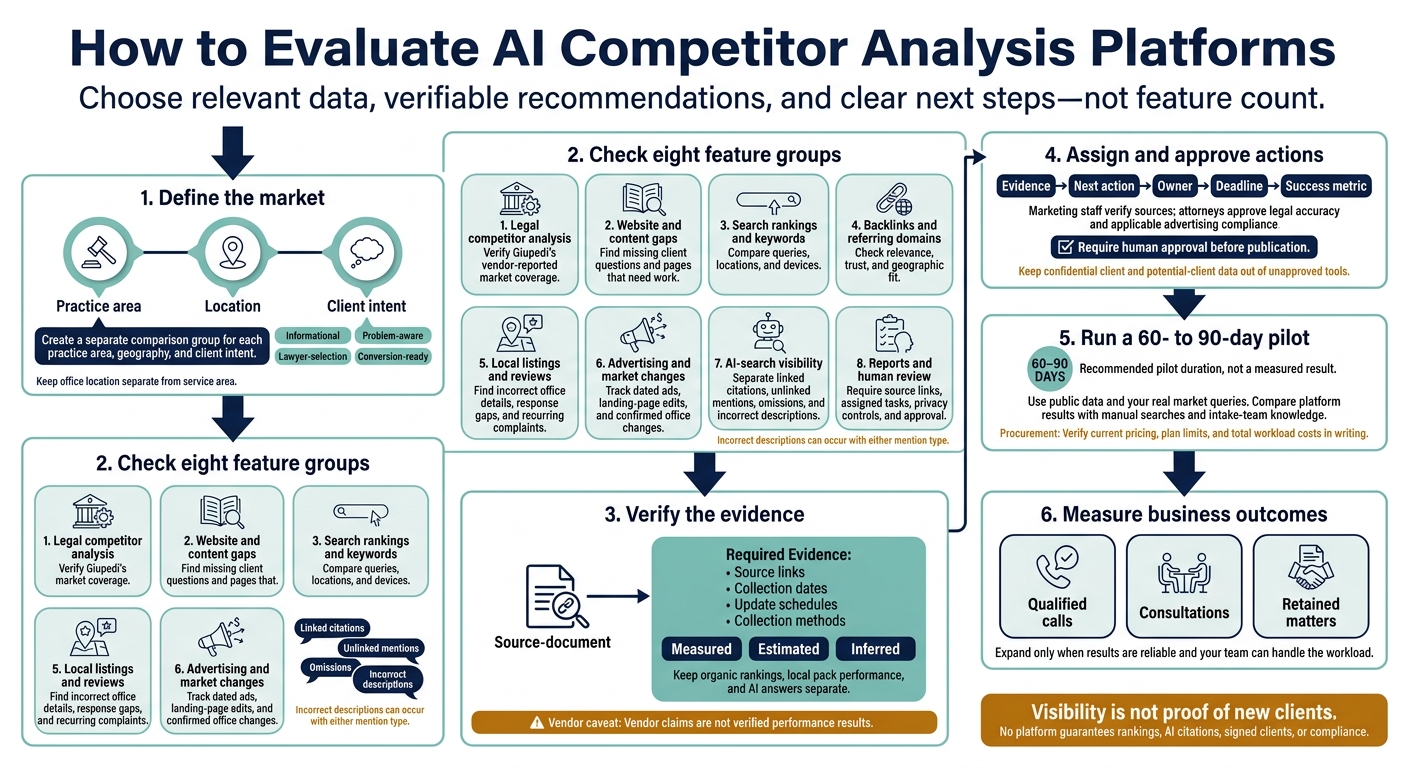
How to Evaluate AI Competitor Analysis Platforms
How to use AI to do quick competitive analysis
sbb-itb-7e4986a
Set Your Practice Area, Location, and Client Intent
Create a separate comparison group for each practice area, geography, and client intent instead of relying on one firm-wide average. Give each group its own queries and conversion goals, such as consultation calls or completed intake forms. For workers’ compensation, apply state-specific filters because eligibility and filing rules differ by state. Set these filters before comparing traditional vs AI-powered legal marketing signals like rankings, reviews, backlinks, or AI citations.
Build location filters from the state level down to ZIP codes, where needed. Keep the firm’s office address separate from its service area, and test ZIP codes that reflect that area - not just the office location. Local rankings depend on relevance, distance, and prominence. A location page alone doesn’t prove that a firm has meaningful local coverage.
Label intent as informational, problem-aware, lawyer-selection, or conversion-ready. Compare educational pages with other educational pages, not consultation pages. Also label each result by source type: local firm, national firm, publisher, directory, or government/nonprofit source. A national publisher may attract attention without competing for local representation. These labels keep later comparisons tied to the same market, intent, and source type.
Track organic rankings, local pack performance, and AI answers in separate columns so you don’t mix signals. For AI answers, distinguish a firm mention from a linked citation, a direct recommendation, or a general reference. Save the exact query, location, device, platform, date, and screenshot. Repeat the process monthly for consistency.
1. Legal Competitor Analysis: Giupedi AI Legal Marketing Platform
According to the vendor, Giupedi combines competitor insights, GEO, content creation, publishing, and human review. These are vendor claims, not verified performance results.
With those filters in place, assess Giupedi’s source coverage, practice-area fit, and review controls.
Source Coverage and Update Timing
Check which sources Giupedi covers, how often it updates them, and what limits apply to your selected plan. Ask for source links, collection timestamps, and a sample report before relying on its insights. Without source details and update timing, you can’t act on the findings. Understanding how AI changes legal marketing helps firms evaluate these data sources more effectively.
Practice-Area and Geographic Fit
Start with the practice areas Giupedi names: personal injury, workers’ compensation, and mass tort. Check whether its output supports state-specific content about claims, deadlines, and appeals.
Useful Outputs
Ask for a demo that takes a content gap, turns it into an editorial brief, identifies authoritative sources, and sends the draft for approval. For GEO, separate mentions from citations. Both need to trace back to source data to be useful.
Transparency and Review Safeguards
Vendor plan descriptions list monthly, weekly, or daily human review. Confirm who reviews the work and what that review covers. Require attorney review of deadlines, eligibility statements, testimonials, and outcome claims. Before uploading confidential client data, check the platform’s privacy, retention, and sharing terms.
2. Website and Content Gap Analysis
Page Scope and Update Timing
After checking platform coverage, review the pages themselves. Compare individual pages, not just domains. Include practice-area pages, service descriptions, attorney biographies, case-result pages, FAQs, blog posts, downloadable guides, videos, and conversion elements such as AI-driven ad campaigns, consultation forms, and phone calls.
Track unanswered client questions, weak explanations, and unclear next steps. These findings help the team decide whether to revise, expand, or retire a page. Record crawl dates, publication dates, and the dates of the last material updates. Review evergreen content quarterly or semiannually, and after legal changes.
Practice-Area and Geographic Fit
Match each gap to the page’s practice area, jurisdiction, and search intent.
For workers’ compensation, cover denied claims, temporary disability benefits, and hearings - not unrelated topics.
Before treating unanswered jurisdiction-specific questions as content opportunities, check questions from page headings and search queries against intake records.
Useful Outputs
A page-level report should identify the target URL, comparison URLs, missing questions, intended audience, suggested page type, priority, and next action. Keep measured gaps separate from generated recommendations, and explain each priority. Map every gap to a client question and a next step.
Transparency and Review Safeguards
Check that recommendations flag duplicate, outdated, thin, poorly linked, or overly promotional pages, along with unsupported claims and copied wording. Do not optimize for word count. Keep the evidence behind each recommendation and send it for reviewer approval.
3. Search Rankings and Keyword Benchmarks
Once you’ve identified content gaps, check whether those pages rank for the queries that matter in each practice area and location.
Ranking Inputs and Cadence
For each ranking, record the keyword, ranking URL, search engine, device, location, result type, and check date. Keep Google Search Console data separate from competitor estimates. Google Search Console reports average position - not a fixed rank - and some unseen impressions may never receive a recorded position.
Track volatile terms daily. Use weekly or monthly checks for planning.
Practice-Area and Geographic Fit
Apply the same practice-area filters to compare rankings by query type and location. For law firms, benchmarks should show which practice-area pages gain visibility in each service area - not just which pages rank overall.
Measure keyword coverage as a percentage of priority terms, rather than a raw total. Report organic, local-pack, mobile, and desktop rankings separately so one strong market doesn’t hide weaker coverage elsewhere.
Useful Outputs
Request practice-area scorecards showing top-3, top-10, and positions 11–20 rankings, along with keyword gaps and ranking URLs. Include estimated monthly search volume, its source, geography, and date range. Google Keyword Planner estimates show demand, not guaranteed visits.
Label search intent so high-volume research terms don’t take priority over consultation-focused opportunities. Tie each recommended action to moving consultation-ready terms into the top 10 or fixing page-level gaps that affect intake.
Transparency and Review Safeguards
Require disclosure of sampling methods, aggregation rules, and missing results. Keep impressions, clicks, and CTR separate from rankings, and avoid counting multiple URLs from the same firm twice. Record the decision and the next measurement date.
If rankings still lag after intent and geography are aligned, check link authority and local prominence next.
4. Backlinks and Referring Domains
A backlink is a single link to your site. A referring domain is a separate site that links to you. Track both, but give relevance and trust more weight than raw totals. Authority scores measure link popularity - not quality. Read them alongside traffic, topical fit, geography, and trust.
Source Coverage and Update Timing
Ask for the data source, update schedule, first-seen and last-seen dates, and confirmation that each link still resolves. Backlink indexes aren’t complete. A missing link may simply not have been found, while a listed link may have disappeared, redirected, or become inaccessible.
Compare monthly changes using the same source and date range. Label these index-reported changes, not confirmed gains or losses.
Practice-Area and Geographic Fit
Filter referring domains by practice area, city, county, and state to find signals that support visibility for the matters you want to handle, often requiring a choice between SEO and GEO strategies. Give priority to local professional and community sources.
Relevant sources include bar associations, legal aid groups, and local chambers.
Separate links to service pages from links to unrelated content. A high authority score alone doesn’t make a source worth pursuing.
Useful Outputs
Request a referring-domain gap report, new- and lost-link alerts, and an opportunity list ranked by priority. Each opportunity should include the linking URL, target page, anchor text, link attributes, relevance, and recommended action.
Track referral visits and consultations, too - not just link counts.
Transparency and Review Safeguards
Require reasons and confidence levels for AI recommendations, then check the source pages yourself. Google identifies paid ranking links, automated link schemes, and excessive exchanges as link spam. Legitimate paid placements should use rel="sponsored" or rel="nofollow".
Require reviewer approval before outreach or disavowal.
Next, compare how local listings and reviews support the same geographic footprint.
5. Local Listings and Review Analysis
Source Coverage and Update Timing
Use the same office and ZIP filters as the ranking analysis to check listings and reviews. Audit Google Business Profile and key legal directories for names, addresses, phone numbers, websites, categories, hours, service areas, and consultation options. Flag duplicate profiles and missing fields, and record each source and its last update date.
Monitor new reviews daily or weekly, then report monthly trends. Keep ratings separate by source because audience norms and moderation rules differ.
Practice-Area and Geographic Fit
Compare firms by office, practice area, and client intent, rather than firm-wide ratings alone. Distinguish office locations from service areas. Reviews affect local visibility, but they don’t determine rankings on their own. Use these signals to prioritize listing corrections, review responses, and reputation fixes.
Useful Outputs
Request listing corrections, rating distributions, review counts, review recency, unanswered-review rates, and response-time trends. Break topic reports into intake responsiveness, case updates, fee clarity, and staff courtesy. Give each action an owner and a deadline.
Treat repeated communication complaints as intake signals. Before changing a process, check those complaints against call logs, form responses, and consultation conversion data.
Transparency and Review Safeguards
Sentiment analysis produces inferences, not facts. Require supporting review text, sample sizes, and confidence levels. Send ambiguous language and clusters of negative reviews for human review.
Public replies need attorney or compliance approval. They must not confirm a client relationship or reveal case details. Avoid fabricated, incentivized, or selectively solicited reviews.
6. Advertising and Market Changes
After checking rankings, links, and reviews, look at AI legal marketing products for paid media and market shifts that can change visibility fast.
Source Coverage and Update Timing
Track competitors’ ad headlines, calls to action, landing pages, social posts, and related market news. Google’s Ads Transparency Center can help you find search, display, and YouTube ads, but it doesn’t establish spend or performance.
Request daily or weekly checks that record first-seen and last-seen dates, screenshots, archived page versions, and collection location. A few isolated sightings don’t prove that an ad ran continuously.
Practice-Area and Geographic Fit
Filter activity by practice area, jurisdiction, language, and client intent. When assessing expansion to explain visibility changes by practice area and location, look for several signals: new city pages, attorney bar admissions, office-opening notices, and sustained local ads.
A new location page alone does not prove a staffed office or authority to practice.
Useful Outputs
Require an ad library, a landing-page change log, and alerts you can configure by firm, city, and practice area. Compare ad promises with page content, consultation forms, and phone or chat options.
Keep social activity separate from lead or case volume. This distinction is critical when evaluating how AI transforms legal client acquisition across different channels. Use the alerts to update the next monthly comparison.
Transparency and Review Safeguards
Separate observed changes from inferred plans. Attach supporting material, a confidence level, and observation dates to every alert.
Ad copy or design changes alone don’t tell you which version converts best. That requires performance data. Before adopting a recommendation, require attorney review of guarantees, comparative claims, testimonials, and solicitation language under applicable state rules.
7. AI-Search Visibility and Brand Mentions
Use the same practice-area, location, and intent filters to track how your firm appears in AI search.
Source Coverage and Update Timing
Archive each run, including the exact prompt, full answer, date and time, language, location, AI product, and cited URLs. Record the model or search environment when available. Check weekly or biweekly. Google notes that AI Overviews and AI Mode can return different answers and links.
Practice-Area and Geographic Fit
Group prompts by practice area, city or state, and intent: informational, urgent, or hiring. For each answer, identify its source types, such as firm pages, bar profiles, court or government pages, legal directories, local publications, and reviews. Flag outdated or conflicting details. Don’t assume your firm’s website drives the answer.
Useful Outputs
Require separate counts for cited mentions, unlinked mentions, omissions, and inaccurate descriptions. Track inaccurate descriptions separately because they can occur with either mention type.
Reports should include the prompt, cited sources, repeat-appearance rate, and recommended source corrections. They should also include source-level gap analysis and trend charts.
Transparency and Review Safeguards
Require disclosure of sampling methods, geographic settings, missing model details, exact prompt wording, and rules for counting duplicate mentions. For Giupedi AI Legal Marketing Platform, verify these reporting features directly.
Use the findings to check whether the platform’s reports and recommendations can be reviewed, acted on, and traced to sources. Send incorrect licensing, office, credential, or case-result claims to an attorney. Do not publish corrections without attorney approval.
8. Reports, Recommendations, and Human Review
Source Coverage and Update Timing
Require a dashboard that connects rankings, reviews, local visibility, and intake conversions. Label each metric as measured, estimated, or inferred, and prioritize changes most likely to drive qualified inquiries and consultations.
Review summary reports monthly or quarterly. Show each metric’s last update date, and use those dates alongside trend views to distinguish platform-tracking changes from market changes. Label the two separately.
Practice-Area and Geographic Fit
Filter results by practice area, jurisdiction, language, and intent, then configure alerts for those segments. Set thresholds for changes that trigger alerts. Escalate broken intake forms and incorrect contact details before tackling content tasks.
Useful Outputs
Require PDF or CSV exports and a prioritized action list covering content, local visibility and AI search, and intake improvements. Each task should include evidence, expected benefit, effort, owner, deadline, and a success metric.
Track tasks from assignment through approval and measurement. Judge completed work by qualified inquiries and consultation conversions - not rankings alone.
Transparency and Review Safeguards
Every recommendation should link to its source or dataset and distinguish observed changes from AI interpretation. Use only aggregated intake data. Verify encryption, access controls, audit logs, retention and deletion policies, and no-training terms.
Require human approval before publication. Marketing staff should verify sources. Attorneys should approve legal accuracy and compliance with state-specific advertising rules, including those covering testimonials, specialization claims, fees, and disclaimers.
Record the approver, review date, and policy applied. Match the depth of review to the task; legal claims that address the substance of the law need attorney review. Compare platforms on how well these controls support data quality, workflow, and review depth.
Feature Comparisons: Data, Uses, and Limits
This comparison helps separate useful signals from estimates and snapshots that depend on search conditions.
Match the data to the decision. Check whether inputs come from public observations, third-party databases, manual research, or your firm’s connected accounts. Keep modeled estimates separate from observed data.
Use each feature to identify what to fix, what to verify, and what not to read too much into. The same signal can mean different things across practice areas, locations, and search intent.
| Feature group | Data inputs | Law-firm use | Typical outputs | Main limits |
|---|---|---|---|---|
| Website and content gaps | Crawled pages, titles, headings, practice-area topics, indexed URLs, internal links | Find missing practice-area pages and weak jurisdiction coverage | Topic gaps, page comparisons, content briefs, technical alerts | Crawlers can miss content; a gap does not prove demand or competitiveness |
| Search rankings and keywords | Target queries, locations, devices, ranking positions, search-volume estimates | Prioritize pages tied to consultation-ready queries in target locations | Position reports, keyword overlap, SERP features, visibility trends | Rankings depend on search conditions; search volume is an estimate |
| Backlinks and referring domains | Crawled links, referring domains, anchor text, link targets | Find editorial opportunities tied to the firm’s practice areas and jurisdictions | Referring-domain lists, link comparisons, relevance checks | No index is complete, and a link does not prove lead value |
| Local listings and reviews | Business profiles, directories, categories, addresses, phone numbers, reviews, ratings | Correct profile details and address response gaps by office and practice area | Listing consistency, review counts, ratings, response monitoring, map-pack visibility | Listings and reviews can be incomplete or out of date |
| Advertising and market intelligence | Detected ads, ad copy, landing pages, keywords, estimated CPC and spend, third-party panel estimates | Assess messaging and campaign priorities by practice area, location, and intent | Ad examples, keyword overlap, estimated spend, trend charts | Coverage may be limited, especially for small or niche domains |
| Visibility type | Metrics | Measurement context | Interpretation limits |
|---|---|---|---|
| Organic search | Position, ranking URL, keyword coverage, search-result features | Query, location, device, language, date | A ranking snapshot is not traffic or a retained client |
| Local search | Local Pack presence, map-grid positions from defined points, Google Business Profile completeness, categories, review count, rating, recency | Searcher coordinates, query, profile location, date | Local results vary by query and searcher location; ratings do not establish legal quality |
| AI search | Mentions, citations, links, description accuracy, practice-area and jurisdiction match | Fixed prompts, AI system/model, location, date, repeated tests | Citation frequency is not market share, legal authority, or referrals |
Relevance matters more than raw totals. Before acting, record the source type, jurisdiction, practice-area relevance, publication date, page status, confidence level, and verification date.
| Analysis | Advantages | Drawbacks and checks |
|---|---|---|
| Backlinks | Finds bar resources, local publications, and community connections | Check editorial context and legal relevance; a relevant link does not guarantee ranking power |
| Listings | Finds inconsistent contact details, categories, and office information | Check duplicate, outdated, or incorrectly merged profiles against the firm’s official website |
| Reviews | Shows themes around communication and responsiveness | Verify context and whether reviews are genuine; sentiment tools can misread language. Avoid unnecessary personal details or inferences about confidential cases |
| Monitoring area | Coverage to check | Update frequency to verify | Recommended use |
|---|---|---|---|
| Advertising | Search-ad copy, landing pages, calls to action, ad-library records | Source update interval and last observed date | Compare messaging and flag claims for compliance review. Modeled traffic, spend, conversions, and leads are directional only; they do not prove budget or intake performance. |
| Social | Public posts, engagement, hiring, community activity | Collection interval and whether edits or deletions are recorded | Plan educational content; do not treat engagement as qualified leads |
| Market trends | Office openings, regulations, news, query trends | Source publication date, collection interval, reporting lag | Revisit service pages and campaign priorities when changes are confirmed |
Giupedi Plans: Pricing, Coverage, and Support
Match your plan to your practice area, content volume, and review process - not just the lowest price. Your reporting and approval needs should guide the choice.
Pricing and included features are vendor-reported and unverified as of October 26, 2026.
| Plan | Monthly price | AI-search coverage | Content capacity | Human support | Mobile access | Best fit |
|---|---|---|---|---|---|---|
| Basic | $499 | ChatGPT analysis; competitor analysis | 4 articles/month | Monthly human-in-loop support; premium support listed | Not specified | Four monthly deliverables and ChatGPT-focused monitoring |
| Intermediate | $999 | ChatGPT, Perplexity, and Gemini analysis; confirm competitor-analysis access | 9 articles/month | Weekly human-in-loop support | Mobile apps listed | Nine monthly deliverables and multiplatform monitoring |
| Expert | $2,499 | Broad LLM coverage; confirm exact platforms | 12 articles/month | Daily human-in-loop support | Mobile apps listed | 12 monthly deliverables, broader monitoring, and frequent support |
Confirm the current price in writing before purchasing. Vendor pricing sources conflict, listing $499, $2,499, and $4,999 per month. Article counts are capacity limits - not guarantees of publish-ready content.
Check what each plan includes, what it leaves out, and which details still need verification:
- Content and publishing: Confirm article limits, revisions, source citations, rollover rules, and CMS compatibility.
- Support and legal review: Ask what monthly, weekly, or daily support covers, including response times, meetings, revisions, and assigned personnel. Verify whether attorney review is included and fits your firm’s approval process.
- Mobile access: Confirm whether access means native apps or mobile web, and whether it includes dashboards, approvals, alerts, collaboration, and exports.
Buying Checklist: What to Verify
Ask for dated sources, collection methods, update schedules, and clear labels separating observed results from estimates.
Use this checklist to check whether the platform can back up its claims.
| Firm requirement | Required capability | Evidence to request |
|---|---|---|
| Relevant local competitors | Filters for practice area, jurisdiction, city, service area, and intent; an editable competitor list | A city-specific report with search terms, location settings, dates, competitor-selection criteria, and exclusions |
| Useful content gaps | Page-level comparisons by topic, intent, and jurisdiction | A source-linked example showing both URLs, the missing topic, and a recommended action |
| Reliable keyword benchmarks | Rankings broken down by location and device; volume and difficulty estimates labeled by source | An export with collection dates, sources, ranking definitions, and methodology |
| Meaningful backlink data | Unique referring domains rather than total links; relevance and quality checks | Source URLs, target pages, discovery dates where available, and flags for low-quality, paid, toxic, or irrelevant links |
| Accurate review monitoring | Location-level review volume, rating, recency, themes, and responses | A source-linked review report and alert history showing each trigger, timestamp, and recipient |
| Advertising and market changes | Dated ads, landing-page changes, and changes to offices and practice areas | Archived evidence, source details, date ranges, and explicit labels for estimated spend |
| Verifiable AI-search visibility | Repeated prompt tests showing mentions, citations, and changes over time | Dated AI-response samples with exact prompts, engine, location, response, and cited sources |
| Actionable reporting | Priorities linked to relevance, effort, confidence, owner, and success metric | Sample recommendations and CSV or PDF exports that retain dates, filters, and URLs |
| Controlled use | Human approval, access controls, and documented data-handling controls | Approval controls plus terms covering retention, deletion, ownership, breach notification, and model training |
Once you've reviewed the evidence, test the platform in your own markets.
Run a pilot with publicly available firm and competitor data and the queries you actually use. Compare the results with manual searches and what your intake team knows. Repeated AI-response tests can show a pattern - they don't guarantee future visibility.
Price the workload you'll actually use: offices, jurisdictions, practice areas, competitors, keywords, prompts, engines, users, reports, alerts, and monitoring frequency. Ask for a written total that covers overages, historical data, exports, API access, onboarding, implementation, support, and cancellation. Don't judge value by the monthly headline price.
Keep confidential client and potential-client data out of unapproved tools. Require human approval before publishing, changing listings, responding to reviews, or launching ads. ABA Formal Opinion 512 addresses competence, confidentiality, supervision, candor, and safeguards for generative AI use.
Conclusion: Choose Relevant Data and Clear Next Steps
Choose fit over feature volume. Review the full stack rather than relying on one metric. Compare features, then ask whether the platform helps your team act on relevant, measurable signals for your practice areas and locations.
For Giupedi AI Legal Marketing Platform, check that coverage meets your firm’s needs. Use the same filters applied throughout this guide: practice area, location, intent, and reviewability. Match outputs to your goals and workflow. Each useful recommendation should link an issue to a practice area, location, owner, and measurable goal.
Once coverage and workflow fit are clear, run a 60- to 90-day pilot. Track qualified consultations, retained matters, and answered calls. Expand only when results are reliable, your team can handle the workload, and outcomes align with your goals - not just dashboard activity. No platform guarantees rankings, AI citations, signed clients, or compliance. Visibility data can guide action, but it doesn’t prove performance. Use the platform only when it improves decisions, not just reporting.
FAQs
Which features should a small law firm prioritize?
Prioritize AI features that reduce routine work, improve local visibility, and help you connect with clients. Focus on automated lead generation and intake tools that assess inquiries by case type, so your team can spend more time on high-value clients.
Use generative engine optimization (GEO) to improve visibility in AI-driven search. Pair it with AI content creation to produce legal resources that address local needs and answer readers’ questions.
Track key performance indicators (KPIs), including search rankings and client acquisition costs, to guide your marketing budget and improve how you spend it.
How can I attribute new clients to AI-search visibility?
Track “AI discovery” during lead intake by asking:
“How did you first learn about our firm?”
Include “AI” as an answer option. Each week, test key queries for your practice areas and locations. Record whether AI responses mention your firm and the context of each mention. Also watch for indirect signals, such as spikes in direct traffic or branded searches.
Use LegalService/Attorney/FAQPage/Organization schema to help AI systems reference your firm accurately. Check server logs to see which pages AI crawlers visit most.
How much data makes competitor insights reliable?
Reliable competitor insights start with a clear baseline - not a set amount of data. Record publication frequency, content formats, author credentials, and specific legal claims. Then keep monitoring competitor activity.
Use AI to set priorities, not to verify findings. A human reviewer needs to confirm extracted claims and cited authorities. Consistent manual testing and tracking query performance over time remain the standard for checking reliability.