AI can help law firms spot patterns in public social posts - not prove which posts bring in clients. Compare matching 30-day periods, check AI labels against source posts, and use the findings to test original content.
The process has three parts:
- Collect within the rules: Use permitted sources, record access gaps, and keep confidential client data out of AI tools.
- Pair AI with manual review: Let AI sort topics and questions, then have reviewers check context, errors, and legal claims.
- Measure intake separately: Set a four- to eight-week baseline and track qualified inquiries, consultations, and signed matters - not just likes and comments.
Before publishing or sending targeted outreach, obtain lawyer review under applicable advertising, privacy, and solicitation rules. Keep source records, corrections, and approvals so each marketing decision can be checked.
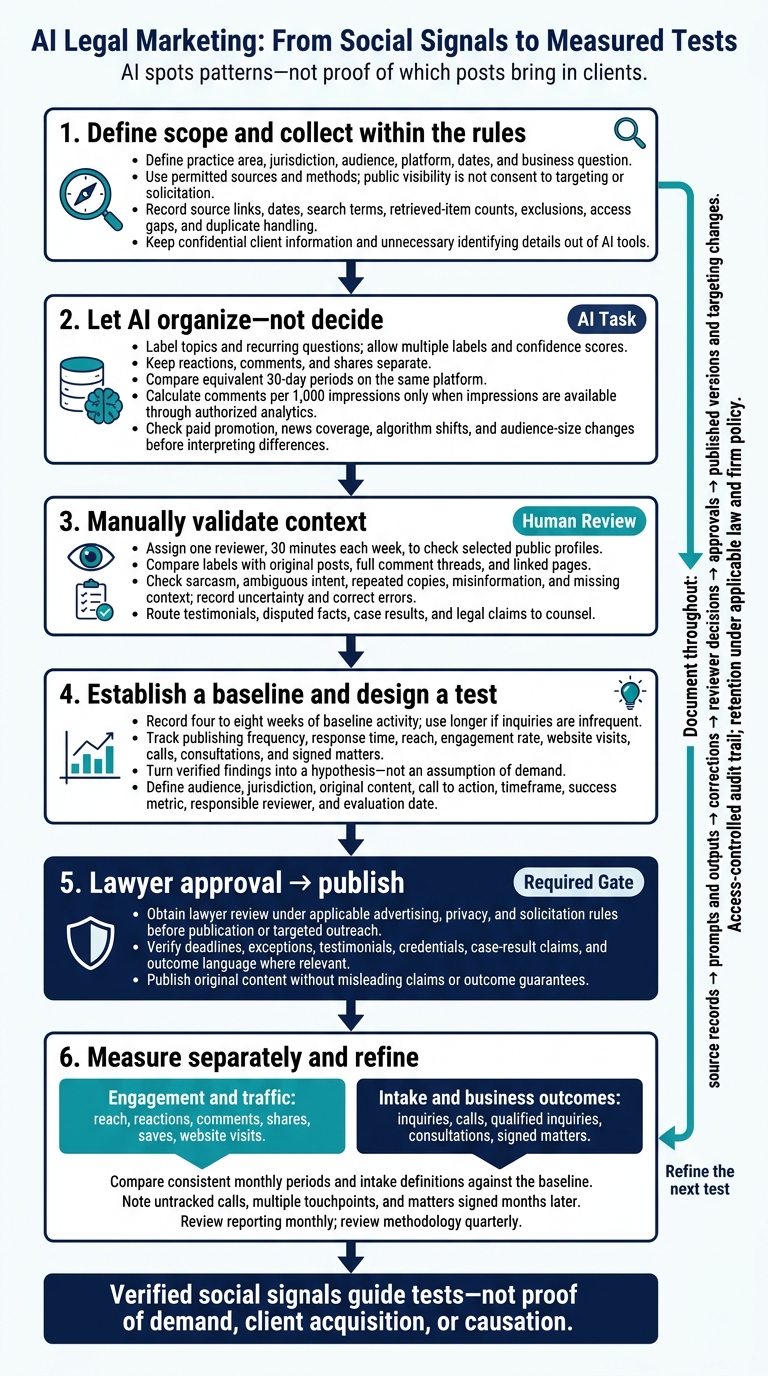
AI Legal Marketing: From Social Signals to Measured Tests
1. AI-Assisted Social Media Analysis
Use AI to label public posts at scale, then check the labels manually. For personal injury topics, separate accident types, medical treatment, insurance disputes, statute-of-limitations questions, and lawyer-selection questions. Allow multiple labels and a confidence score instead of forcing every comment into one category. This turns broad topic sorting into information marketers can use.
Have AI summarize recurring questions, separating requests for information from news-driven reactions, service-related concerns, and service inquiries. Each report should include the date range, search terms, number of retrieved items, and excluded material. Keep dated source links so reviewers can confirm that a theme appears in separate comments - not just repeated copies of the same post.
Keep engagement measures separate. Track reactions, comments, and shares individually. Also track public reply patterns, including reply rate and response time. Calculate comments per 1,000 impressions ONLY when impressions are available through authorized analytics. Treat sentiment labels as a guide, not a final judgment: sarcasm, urgency, and mixed emotions can change a comment’s meaning.
Compare equivalent 30-day periods on the same platform to spot changes in posting frequency, topics, calls to action, and audience questions. Before changing content or targeting, optimizing for AI search can help, check whether paid promotion, news coverage, algorithm shifts, or audience-size changes could explain those differences. A recurring report can highlight the top five recurring questions, unanswered public comments, and findings that need attorney or compliance review. Manually review the flagged shifts next.
Access limits define report coverage. A post being public doesn’t override API terms, permissions, or rate limits. Mark deleted, private, restricted, paywalled, and otherwise unavailable history as missing. Record what the report included, what was unavailable, how duplicates were handled, and how classifications were reviewed.
sbb-itb-7e4986a
2. Manual Social Media Monitoring
Use manual monitoring to check AI flags and catch missing context. Assign one reviewer to spend 30 minutes each week checking selected public profiles. Track the URL, date, posts per week, topic, format, and visible reactions, comments, and shares in one spreadsheet. Note the likely audience, but don’t assume commenters are potential clients.
Compare reports by topic and format - not total activity. Posting frequency alone doesn’t prove business value. Keep raw counts alongside per-post averages so you can check whether traditional vs AI-powered legal marketing labels match the actual conversation.
Read full comment threads and linked pages before interpreting unclear language. Label responses by intent: question, complaint, referral, praise, misinformation, or unrelated response. Record uncertainty, and don’t mistake frustration for a request for representation. These checks help validate the topic mix, engagement quality, and legal-risk content flagged by AI.
High-risk content needs a separate review. Treat testimonials as marketing claims, not proof. Check for a genuine client experience, required disclosures, and wording that suggests typical or guaranteed results. The FTC says endorsements must reflect honest experiences and cannot make deceptive claims.
For deaths, injuries, arrests, or active litigation, check timing, source reliability, jurisdiction, and potential harm before using the material. Leave unnecessary identifying details out of reports. Manual review provides context - not proof - so route testimonials, disputed facts, case results, and legal claims to counsel before they guide content strategy.
Use Verified Social Signals to Guide Marketing
Treat verified AI or manual signals as ideas to test, not proof of demand. Start with verified findings, run a content test, then measure intake.
Record four to eight weeks of publishing frequency, response time, reach, engagement rate, website visits, calls, consultations, and signed matters. Use a longer baseline if inquiries are infrequent.
Turn Observations Into Content Plans
Hypothetical example: Repeated questions about reporting workplace injuries could justify testing a state-specific checklist - not assuming demand for representation - with a lawyer verifying applicable deadlines and exceptions before publication.
Hypothetical decision table
| Observed social signal | Likely meaning | Required verification | Permissible marketing response |
|---|---|---|---|
| Repeated workers’ compensation deadline questions in one state | There may be a jurisdiction-specific information gap | Check context, jurisdiction, dates, deadlines, exceptions, and lawyer approval | Publish an original state-specific explainer without outcome guarantees |
| Many comments on a claim-documentation video | The format may encourage questions | Compare similar posts against the firm’s baseline | Test an original video with approved language |
| Frequent practice-area questions but few website visits | Awareness exists, but intent is unclear | Check tracking, page relevance, mobile usability, and intake records | Improve the educational page and call to action before expanding distribution |
For each test, save source references, dates, sample size, proposed action, responsible reviewer, approval date, and evaluation date. Write in the firm’s own voice. Don’t copy another firm’s wording, testimonials, or claims.
Before publication, define the audience, jurisdiction, call to action, and evaluation metrics. Get approval before publishing, then track whether the post changes inquiries and lead generation - not just engagement.
Track Inquiries Separately From Engagement
After each content test, measure intake separately from public engagement. Report reach, comments, saves, and visits on separate lines from inquiries, calls, consultations, qualified inquiries, and signed matters.
Compare results with the baseline using consistent monthly periods and intake definitions. Match campaign tracking against intake records, noting untracked calls, multiple touchpoints, and matters signed months later.
Giupedi’s Role in the Process
Use verified social findings to guide content priorities within the Giupedi AI Legal Marketing Platform’s AI-driven legal marketing and generative engine optimization (GEO) workflows. Have a lawyer review content before publication.
Privacy, Advertising Rules, and Lawyer Review
Once social signals are verified, check whether they can be used in marketing at all.
ABA Model Rule 7.1 bars false or misleading legal-marketing statements, and jurisdictional rules control. Formal Opinion 512 applies competence, confidentiality, and supervision duties to generative AI. Vendor promises do not establish compliance, and manual collection must meet the same duties.
Limit Collection and Protect Client Information
Collect only lawfully available public information using permitted methods. Record source links, dates, collection methods, and context. Public visibility is not consent to targeting or solicitation.
Do not put confidential client information, intake records, case materials, or identifying details into AI systems without authorization and safeguards. Check vendor policies on retention, training, access, and deletion. Initials alone do not de-identify data.
With collection limited and documented, check whether the AI output supports any lawful marketing claim.
Check Findings and Approve Marketing Claims
Assign a supervising lawyer who understands the tool’s limits to oversee staff, contractors, and vendor work. Compare AI summaries, sentiment labels, classifications, and inferred intent with the original posts. Check for sarcasm, quotations, and missing context.
The supervising lawyer must check claims about credentials, specialization, testimonials, past results, and likely outcomes against supporting records before approving them. Review endorsements for accuracy and material connections under applicable bar rules and FTC requirements.
Before sending outreach prompted by an apparent legal problem, screen it under local solicitation rules. An educational post and a targeted message pose different concerns.
After approval, preserve the source trail so the decision can be audited later.
Document Sources, Corrections, and Approvals
Keep an access-controlled audit trail that links prompts, outputs, corrections, and reviewer decisions to the original public content and manual review notes. Save the published version and targeting settings, including later changes or takedowns. Set retention periods under applicable law and firm policy.
Conclusion: Pair AI Analysis With Human Review
AI adds scale; human review adds context and accountability. Use both to guide tests - not to claim results.
Before changing content, use this final check to validate AI labels and manual observations. Verify the data, review process, and business outcome you want to measure so marketing decisions meet compliance requirements and can be tested.
- Scope: Confirm the practice area, jurisdiction, audience, platforms, dates, and business question.
- Permitted collection: Verify that collection and use are authorized. Exclude confidential data and personal data you don’t need.
- Normalize metrics: Account for platform, format, audience, and paid versus organic status. Even normalized metrics don’t make all channels directly comparable.
- Classification: Define labels, confidence thresholds, and rules for ambiguous cases.
- Manual validation: Check a representative sample and correct errors.
- Marketing hypotheses: Specify the audience, content test, timeframe, and success metric. Get the appropriate review.
- Intake outcomes: Track qualified inquiries, consultations, retained clients, and relevant matter outcomes separately from engagement. Disclose attribution gaps.
- Review cadence: Review reporting monthly and methodology quarterly. Log changes and approvals.
FAQs
How much social data does my firm need for reliable insights?
Reliable insights start with a baseline of existing content and competitor activity, not a set volume of social data. Record how often content is published, which formats are used, author credentials, and legal claims. Pair AI-driven observations with consistent manual testing and human review.
For forecasts or budget decisions, aim for at least 30 to 50 conversions per month. Track trends across multiple review periods to separate patterns from one-off events.
How can we tell whether content actually drives inquiries?
Measure client outcomes, not just visibility. Track organic visits, form submissions, calls, qualified inquiries, consultations, and retained matters separately from mentions in AI tools or AI search.
Set a baseline, then check content and prompts monthly. Log each prompt, platform, date, response, citation, accuracy assessment, and review status.
Use qualified inquiries and signed cases to attribute results, and include offline conversions when tracking ad performance. Judge success by qualified calls, consultations, and retained matters - not rankings alone.
When should we reject an AI-generated marketing recommendation?
Reject an AI-generated marketing recommendation if it includes unsupported or potentially misleading legal claims, could violate state ethics rules, or cannot be traced to its cited source or dataset. Watch for inaccurate facts, fabricated sources, outdated rules, unverified credentials, and claims that guarantee results or compare outcomes.
Treat AI output as a draft that requires attorney review. Before publishing or acting on it, check the live content, verify citations, confirm that sources are truthful and accurate, and review compliance with applicable rules.