I’d base a law firm’s marketing budget on expected collections - not lead counts alone. Start by linking spending to qualified inquiries, signed cases, and collected fees. Then set spending limits that account for case costs, payment delays, and how much work your team can handle.
Only 47% of firms surveyed had an annual marketing budget in the ABA’s 2023 Websites & Marketing TechReport. But having a budget is just the start. I’d use predictive analytics to:
- Compare acquisition costs by practice area and marketing source.
- Build low, base, and high forecasts for cases, collections, and staffing.
- Check whether missed calls or slow follow-up are wasting ad spend.
- Test forecasts against actual results before moving money.
- Protect client data and review attorney advertising rules.
The rule I’d keep front and center: <u>a signed case is not cash</u>. Forecasts - including traditional vs AI-powered platform outputs - can guide spending, but they need firm-specific data, human review, and room for uncertainty.
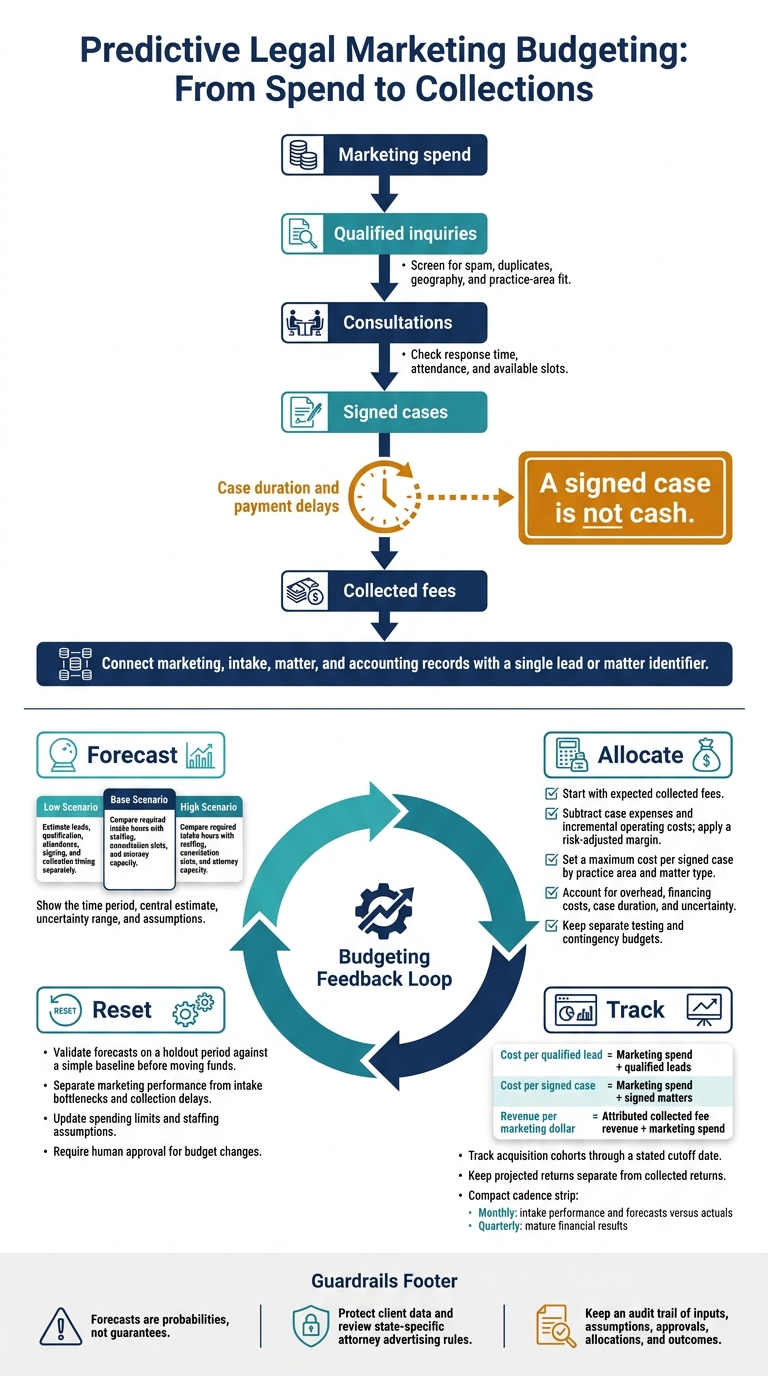
Predictive Legal Marketing Budgeting: From Spend to Collections
Why Law Firms Need Data-Driven Marketing | With Phil Crowley
sbb-itb-7e4986a
Budgeting Problems That Lower Marketing Returns
Repeating last year’s channel mix can repeat last year’s mistakes. When AI tools for legal ad campaigns, intake, and accounting records stay separate, firms cannot reliably connect spending to consultations, signed cases, or collected fees. Incomplete attribution can also give both the first inquiry and the last contact credit for the same client.
Predictive analytics turns these gaps into measurable budget risks by using qualification rates, attribution confidence, response time, intake capacity, and collection lag as forecast inputs.
| Budgeting problem | Budget risk | Predictive control |
|---|---|---|
| Repeating prior allocations without reviewing outcomes | Spending stays concentrated in channels that produce few qualified leads or signed cases | Forecast signed-case probability and acquisition cost by source |
| Treating all inquiries as equal leads | Lead counts overstate qualified prospects and skew channel comparisons | Estimate qualification rates after screening for spam, duplicates, geography, and practice-area fit |
| Keeping marketing, intake, and matter records separate | Spending cannot be reliably linked to consultations, signed cases, or collections | Connect source, intake, matter, and billing data in a forecast model |
| Incomplete attribution across calls, forms, referrals, and repeat contacts | Misassigned credit skews channel budgets | Use source-assisted or multi-touch attribution with confidence levels |
| Missed calls, slow follow-up, and limited intake capacity | Paid inquiries fail to become signed cases | Forecast conversion under different response-time and intake-capacity scenarios |
| Ignoring contingency-fee collection lag | Signed cases are mistaken for near-term cash | Forecast case duration, collection timing, and cash-flow scenarios |
Measure Signed Cases, Not Just Leads
Replace raw lead counts with signed-case tracking. Clicks show attention, not client fit. Separate qualified prospects from spam, duplicates, vendors, existing clients, out-of-area inquiries, conflicts, and out-of-scope matters.
Record specific reasons for declining a case rather than relying on a label like:
“not retained”
That label could mean poor fit, no response, insufficient damages, a conflict, fee disagreement, or intake capacity constraints.
Keep a persistent source identifier attached to each inquiry through consultation attendance and the signed retainer. Use campaign-specific phone numbers, UTM parameters, and form source fields. Merge repeat contacts so one person does not count as several leads.
Review cost per qualified lead, cost per consultation, and cost per signed case - not just cost per inquiry. Start with first-touch and last-touch reporting before moving to more complex attribution.
Account for Collection Delays and Intake Limits
Turn intake bottlenecks and collection lag into forecast assumptions. For contingency matters, assign projected resolution periods, fee ranges, case-cost estimates, and confidence levels. Keep expected collections separate from signed-case totals. Test how delayed resolutions would affect monthly payroll, overhead, and acquisition spending.
Before increasing spending, review missed calls, time to first response, contact rates, consultation availability, and signing rates by source and time of day. Compare those results with intake coverage and attorney schedules. Before calling a channel ineffective, test whether better coverage or more consultation slots would improve conversion.
Build Budget Forecasts from Reliable Data
Once intake and billing data are connected, use them to estimate where each marketing dollar will go. Predictive analytics can turn past and current data into ranges for leads, signed matters, collections, and staffing needs. Attribution assigns credit; prediction estimates what happens next. Present forecasts as probabilities, not guarantees.
Connect Marketing, Intake, and Matter Records
Link marketing, intake, case-management, and accounting records with a single lead or matter identifier. Standardize source, practice area, geography, inquiry date, qualification status, consultation outcome, signed status, fee collections, and spend. Define each term in a data dictionary. Exclude duplicates, spam, existing clients, out-of-area matters, non-marketing referrals, and conflicts.
Reconcile records monthly, and keep enough history for the pattern you’re forecasting. Seasonal estimates need data across seasons; collection forecasts need mature matters. When volume is low, use rolling averages and scenario ranges instead of a complex model.
Calculate Acquisition Costs and Marketing Returns
Define marketing investment once, then use that cost basis throughout. State whether it covers media alone or also agency fees, design and content production, software, tracking, and internal labor. If a denominator is zero, report “not applicable” rather than forcing a result.
Group matters by acquisition cohort and track their collections through a stated cutoff date. Don’t compare those collections with unrelated spending from the month the money arrived. Keep projected returns separate from collected returns. Revenue-based ROI is not net profit: it excludes labor, case expenses, and overhead.
| Metric | Formula | Budget decision | Required data source |
|---|---|---|---|
| Cost per lead | Marketing spend ÷ leads | Compare lead-generation efficiency and spot unusually expensive sources | Advertising platforms, call tracking, form analytics, CRM |
| Cost per qualified lead | Marketing spend ÷ qualified leads | Set spending limits for leads that meet practice-area and geographic criteria | CRM, intake records, campaign-cost data |
| Cost per signed case | Marketing spend ÷ signed matters | Compare the cost of acquiring matters that enter the firm | CRM or case-management system, marketing ledger |
| Revenue per marketing dollar | Attributed collected fee revenue ÷ marketing spend | Estimate cash generated per marketing dollar | Accounting or trust-to-operating transfer records, attribution records |
| Revenue-based marketing ROI | (Attributed collected fee revenue − marketing investment) ÷ marketing investment × 100 | Decide whether to expand, reduce, or test an allocation | Accounting, marketing ledger, attribution records |
Forecast Cases, Collections, and Staffing
Build low, base, and high scenarios for each practice area. Estimate leads, qualification, attendance, signing, and collection timing separately. Then translate those forecasts into required intake hours and compare the workload with staffing, consultation slots, and attorney capacity. Allow for rising acquisition costs, weaker lead quality, and capacity limits. Don’t assume signed matters will grow in direct proportion to spending.
Show each forecast’s time period, central estimate, uncertainty range, and assumptions. Compare predictions with actual results each month, then use the gap to reset spending limits and staffing assumptions.
Allocate Marketing Spending with Forecasts
Use the prior section’s low, base, and high forecasts to set monthly or quarterly spending limits by practice area and channel. Keep those limits within what your intake team and attorneys can handle.
| Approach | Inputs | Timing | Supported decisions | Limitations |
|---|---|---|---|---|
| Static budgeting | Prior-year spending, management targets, fixed channel allocations | Usually annual or quarterly | Set spending ceilings | Does not respond well to changes in conversion rates, case mix, collection delays, or intake constraints |
| Historical ROI reporting | Actual spending, leads, signed cases, and collected fees | Best used after matters mature | Compare channel performance | Cannot anticipate changing conditions; immature matters can skew allocation decisions |
| Predictive planning | Historical outcomes, current funnel data, intake capacity, case attributes, timing, and scenario assumptions | Before and during spending | Set limits, move funds, plan staffing | Depends on data quality, validation, and human oversight; predictions are not guarantees |
Set Acquisition Cost Limits and Review Spending
Start with expected collected fees. Subtract case expenses and incremental operating costs, then apply a risk-adjusted margin to calculate the maximum cost per signed case. Before approving that ceiling, account for overhead, financing costs, case duration, and uncertainty. Set limits by practice area and matter type - the available evidence does not support a universal legal acquisition-cost benchmark.
Keep funding established channels only while results from mature matters stay below that ceiling. Set aside separate budgets for testing and contingencies.
Review intake performance monthly and mature financial results quarterly. Decide how much data you need before judging a channel, and allow normal signing and collection delays to pass before cutting its budget.
Use Giupedi AI Legal Marketing Platform Insights for Planning
The Giupedi AI Legal Marketing Platform can support planning with AI-search visibility and client-acquisition insights. But use those outputs only after checking them against your firm’s intake, signed-case, collection, and capacity data.
Visibility is a planning input - not proof of acquired clients or guaranteed ROI. Back performance claims with firm-specific results and clearly stated assumptions.
Test Forecasts and Protect Client Data
Before moving funds, validate the model on past periods and check for bias. Test forecasts on a holdout period against a simple baseline. Track errors in lead volume, qualified leads, signed cases, collections, timing, and cost per signed case. Check for both historical and geographic bias.
Require human approval for budget changes. Keep an audit trail of inputs, assumptions, approvals, allocations, and outcomes.
Limit the client data you use, restrict access, and use de-identified records where practical. Check vendor terms for data retention, training, access, and deletion. Before using the forecasts, review state-specific attorney advertising and solicitation requirements so approved forecast changes and spending reallocations do not support noncompliant campaigns or unsupported accuracy promises.
Conclusion: Forecast, Track, and Adjust Spending
A sound budget ties spending to acquisition-cost limits, collection timing, and intake capacity. A signed case is not cash; plan for the gap between signing and collection.
Follow a regular cycle: forecast, allocate, track, and reset. At each review, distinguish marketing changes from intake bottlenecks and collection delays. Address the root cause before adjusting spending.
Predictive analytics can help keep budgeting disciplined, but it can't eliminate uncertainty. Let forecasts guide spending - not replace judgment or push the firm beyond its means.
FAQs
How can my firm start forecasting with limited data?
Start by checking which marketing methods bring in clients and revenue. Set measurable goals, then use your current conversion rates to estimate how many leads you’ll need. Track engagement and client acquisition costs with the Giupedi AI Legal Marketing Platform to set a baseline.
Connect your practice management data with key conversion events. This lets AI models spot patterns, seasonal trends, and high-value lead sources to help guide your budget and growth plans.
How do I budget for channels with no track record?
Set aside 10% to 15% of your total marketing budget to test new channels without putting core performance at risk.
Run test campaigns for at least three months to set a performance baseline before scaling. Track cost per acquisition and lead quality to measure returns. When a test succeeds, increase spending gradually while cutting back on channels that underperform.
When is a forecast reliable enough to change spending?
A forecast can guide budget changes when clear performance data and statistical confidence support it. Wait until you’re tracking 30–50 conversions per month before switching to Target CPA or Maximize Conversions. When testing new ad concepts, aim for 90–95% confidence and at least 500 impressions per variant.
Review performance weekly and check quarterly trends. Use those findings to move spending from underperforming channels to those delivering higher returns.