AI can help me watch competitor pages, spot topic gaps, and plan better law firm content for AI search - but it does not replace lawyer review. If I use it the right way, I can track public pages, log page changes, sort content by topic and intent, and turn that research into an original editorial plan.
Here’s the short version:
- I track public competitor content only, such as blog posts, service pages, FAQs, guides, bios, case results, and search listings.
- I log page details like URL, title, page type, city, state, publish/update date, and retrieval date.
- I use AI to flag new pages, edits, deadlines, fee language, case-result claims, and state-specific wording.
- I make AI label each page by practice area, jurisdiction, user need, intent, format, and funnel stage.
- I treat AI output as working notes, not legal advice or verified fact.
- I turn verified findings into an original content plan based on client questions, competitor weak spots, and firm capacity.
- I send every legal claim, comparison, deadline, and ad statement through human review before anything goes live.
- I keep a review cycle: daily, weekly, monthly, and quarterly.
This matters because legal consumers do their homework first. The article cites a 2024 Martindale-Avvo report showing 92.4% of legal consumers research their issue online before contacting an attorney.
What I take from this is simple: AI-powered legal marketing helps me organize and prioritize; lawyers still check the facts, state rules, and ad compliance. That split keeps the process clear - track, review, plan, publish.
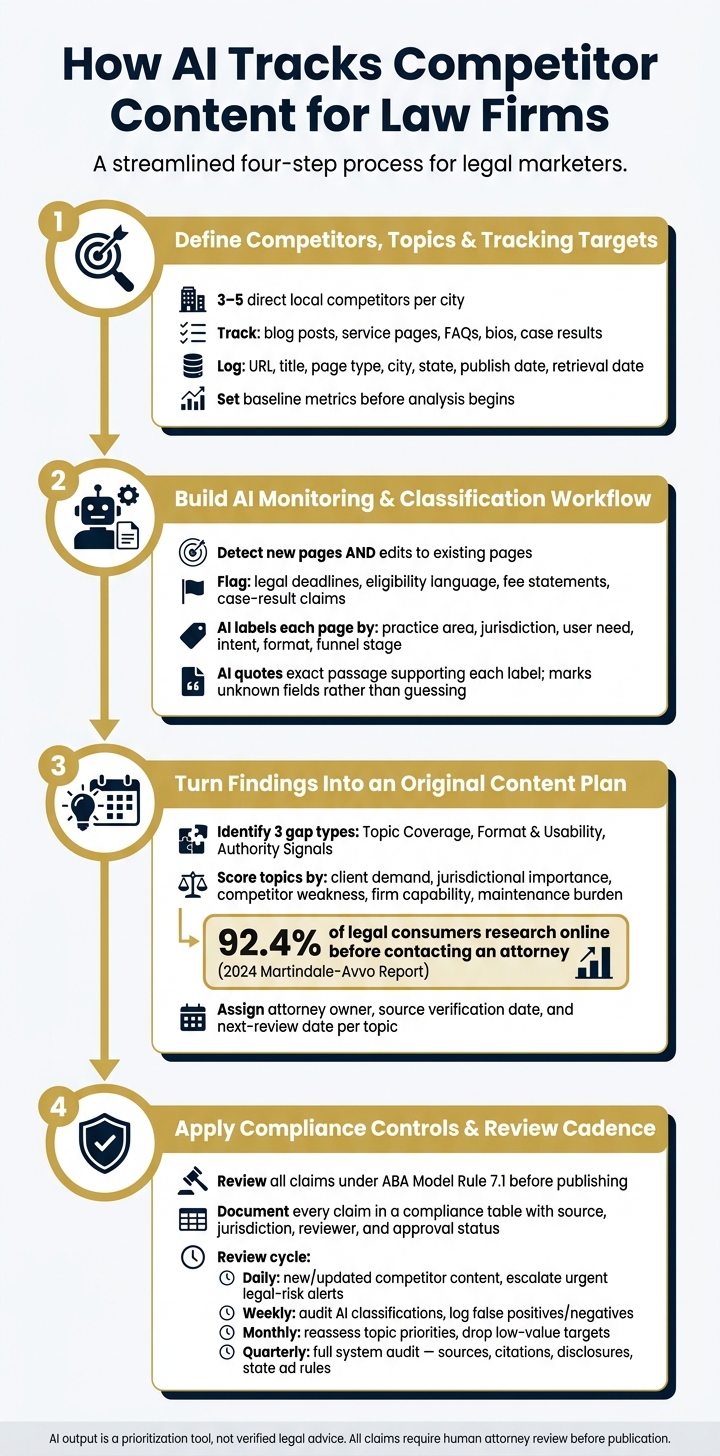
How AI Tracks Competitor Content for Law Firms: 4-Step Workflow
Step 1: Define Competitors, Topics, and Tracking Targets
Start with a short list of local competitors and the page types you want to watch. Once the scope is clear, lock in the exact competitors, topics, and page types you'll track.
List Competitor Domains and Content Sections
Begin close to home. If you're working with a personal injury firm, track the firms that rank for your target city and practice-area searches. A solid starting mix looks like this:
- Three to five direct competitors in each target city
- One or two strong regional firms
- One national result that shows up in the same search results
Track one page per row. For each page, record the competitor, domain, page type, URL, title, practice area, city, state, publication date, last-updated date, retrieval date, call to action, jurisdiction references, and cited authorities.
Keep page types grouped in a simple way: blog posts, service pages, FAQ hubs, location pages, case-result pages, attorney bios, and guides.
Choose Client-Intent Topics to Monitor
Group topics by the client's question, not just the keyword. That's a big deal. People don't search in neat spreadsheet categories. They search when they're stressed, confused, or trying to figure out what to do next.
For a workers' compensation practice, that means tracking topics like denied workers' compensation benefits, appeals, employer retaliation, medical treatment, and filing deadlines. For personal injury, monitor car accident claims, medical documentation, fault, insurance communications, and settlement timelines. For surgical error or medical malpractice matters, focus on proof requirements, expert testimony, and statutes of limitation.
Break topics into three buckets: urgent conversion topics like "denied workers' comp claim" or "schedule a consultation", decision-support topics such as settlement timelines, contingency fees, and what the process looks like, and early research topics like injury definitions, deadlines, and FAQs.
Keep these groups separate by jurisdiction. A page about filing deadlines in Texas should not sit in the same topic group as one covering Florida rules. Deadlines, benefits, and procedures change from state to state.
Set Baseline Metrics Before Analysis
Before AI starts spotting changes or gaps, document what exists right now. That baseline gives you something firm to compare against later.
Useful fields include publication cadence, last-updated date, format, length, CTA count, author or reviewer credit, internal links, and primary-source citations. For search visibility you can observe directly, record the query, city or ZIP code, date, result type, ranking position, and whether the page appears in AI search summaries.
Add an attorney-review priority field to your worksheet. Any page making statute-of-limitations claims, settlement-value statements, or jurisdiction-specific eligibility claims should be flagged for attorney review before you act on any AI-generated observations about it.
Also add a do not copy field for pages that include unsupported guarantees, misleading comparisons, or outdated legal statements. Those pages may still be worth tracking, but they should never become a content model.
Once the baseline is in place, you can move into automated collection and classification. That list becomes the input for AI monitoring.
sbb-itb-7e4986a
Step 2: Build an AI Workflow to Monitor and Classify Competitor Content
Use the baseline from Step 1 to watch for new pages and changes to pages you already track.
Collect New Pages and Detect Page Updates
Track both new URLs and edits to pages that already exist. That includes things like fee statements, jurisdiction updates, attorney bios, and disclaimers.
For each page you capture, save:
- URL
- Competitor domain
- Page title
- Page type
- First-seen date
- Publication date or update date, if the page shows one
- A timestamped snapshot or screenshot recorded in U.S. date and time format with the time zone
- The HTML, when available
Also save the relevant excerpt and note the old and new wording. That part matters a lot. A note that says "disclaimer text revised" doesn't tell you much. A record that shows the exact before-and-after language does.
Use the baseline fields from Step 1 as the comparison point for every new capture.
Before you compare pages, remove the noisy stuff: cookie banners, rotating banners, navigation menus, ad widgets, script-generated timestamps, and changing analytics code. If you skip this cleanup, you'll get false alerts and miss the edits that matter.
Once that clutter is gone, compare the text and page elements. Give top priority to flags tied to:
- Legal deadlines
- Eligibility language
- Fee statements
- Case-result claims
- Jurisdiction references
Store each change in the same record you'll use later for classification.
Use AI to Label Topics, Intent, and Content Format
After a page is captured, AI can sort it into a structure your team can work with. The key is to give the model a fixed label set and require structured output.
Each page should get a label for practice area, jurisdiction, user need, likely search intent, content format, and funnel stage.
For example, a page titled What to Do After a Chicago Truck Accident would be tagged as Illinois-specific, personal injury, informational intent, early-stage education, and guide or checklist format. A page titled Chicago Truck Accident Lawyer - Free Consultation would be tagged as a conversion-focused service page.
The AI should quote the exact passage that supports each label. If it can't back up a field, it should mark that field as unknown instead of guessing.
Even with a high confidence score, a person should still review any page that deals with legal deadlines, outcomes, fees, or jurisdiction-specific advice.
Extract Claims, Sources, and Possible Gaps
For each page, ask AI to pull out:
- The main question the page answers
- The key legal or factual claims
- Any cited statutes or agencies
- The visible author or reviewer
- Publication and update dates
- Calls to action
- Disclaimers
- Follow-up questions the page leaves unanswered
Match every extracted claim with the exact supporting excerpt from the original page. Use the original page as the main source, not the AI summary.
Before any of these findings shape your content plan, a reviewer should open the live page and check the details by hand. That means confirming the excerpt is accurate, making sure cited authorities exist and say what the AI says they say, and checking that attorney names and credentials are shown correctly.
AI output is a prioritization tool, not a verified finding.
Record the change, source excerpt, and review status in the same log. That log becomes the input for the content-planning step.
Step 3: Turn Competitor Findings Into an Original Content Plan
Once you've reviewed your monitoring log, the next move is simple: turn those findings into content your firm can actually own. Step 2 gave you the raw material. Now it's time to move from observation to priority.
Analyze Gaps in Topic Coverage, Format, and Authority Signals
Start by sorting each verified page using the topic, intent, and format labels you already assigned in Step 2. Pull every verified page from the log, then group the findings into three gap types: topic coverage, format and usability, and authority signals.
Here’s the basic idea:
- A topic gap means the page doesn't answer a client question.
- A format gap means the answer exists, but it's delivered in the wrong way.
- An authority gap means the page lacks jurisdiction, source support, or attorney review.
A comparison table helps you spot patterns fast:
| Competitor | URL | Practice Area | Topic | Format | Publication/update date | Evidence cited | Observed gap | Verification status |
|---|---|---|---|---|---|---|---|---|
| Competitor A | /car-accidents/insurance-deadlines |
Personal injury | Insurance claim deadlines | FAQ | March 12, 2026 | State statute; no case citation | Doesn't distinguish filing deadlines from insurer notice requirements | Statute checked; attorney review pending |
| Competitor B | /workers-compensation/benefits |
Workers' compensation | Available benefits | Blog post | January 8, 2026 | Agency guidance; outdated link | Omits state-specific eligibility and benefit limits | Agency source checked; update needed |
| Competitor C | /mass-tort/claim-guide |
Mass tort | Claim process | Long-form guide | November 20, 2025 | Studies and court documents | Explains enrollment but not litigation status or risks | Primary sources pending |
One thing matters here: a gap should point to an unmet client need. It shouldn't just say a competitor wrote fewer words. Word count alone tells you almost nothing. Competitor pages are research inputs, not templates.
Rank Content Opportunities by Client Relevance and Legal Review Needs
Not every gap deserves a spot on your editorial calendar. Before you add a topic, run it through three checks: Do clients ask this? Does the answer change by jurisdiction? Can the firm support and maintain it?
Score each topic based on client demand, jurisdictional importance, competitor weakness, firm capability, and maintenance burden. Put more weight on client demand and jurisdictional importance. If a topic is both heavily searched and tied to state-specific rules, it will usually beat a broad evergreen piece.
According to the 2024 Martindale-Avvo Legal Consumer Report, 92.4% of legal consumers research their issue online before contacting an attorney. That stat matters because it shows where content gaps do the most damage: during the early research phase, when people are trying to figure out what applies to their case.
After a topic clears that filter, choose an original format before drafting starts. For example, a truck-accident topic doesn't have to become another generic article. It could become a first-hour injury checklist paired with a state-specific deadline table. Same subject. Far better use for the reader.
Before anything moves to draft, assign an attorney owner, a source verification date, and a next-review date for each approved topic.
Use Giupedi AI Legal Marketing Platform to Centralize the Workflow
Keep the workflow in one place so your gap analysis, source checks, and review status don't end up scattered across spreadsheets, docs, and email threads. Giupedi AI Legal Marketing Platform is built for that kind of coordination. It connects a monitored competitor page to a topic cluster, logs the gap you found, attaches source requirements, assigns a reviewer, and tracks publication and refresh dates.
It also brings AI search analysis, competitor tracking, content planning, and human review into one system. That matters for law firms because attorney approval is still required before publication. Giupedi keeps the handoff documented, so nothing moves forward without a completed review record.
Step 4: Apply Compliance Controls and Set a Review Cadence
Compliance belongs in drafting, review, and publishing. It is not something you tack on at the end. Once you choose a topic, lock down claims, disclosures, and review timing before anything goes live.
Review Advertising Claims, Disclosures, and Jurisdiction Accuracy
Before you publish any competitor-informed content, send it through a structured claim review. ABA Model Rule 7.1 bars false or misleading statements about a lawyer or a lawyer’s services, and a statement can be misleading even if it is technically true when it leaves out context that changes how a reader reads it. If you make a comparison, you need proof on file. If you do not have that proof, cut the claim.
AI can flag risk during compliance checks. It should not sign off on content. Claims about results, specialization, testimonials, deadlines, and comparisons need human review for source support, jurisdiction, and disclosures.
For case results, add a disclaimer such as "prior results do not guarantee a similar outcome" where required or prudent. For specialization claims, confirm the certification and name the certifying organization when state rules require that detail.
Give each page a jurisdiction. Then require the reviewer to confirm the governing statute, filing deadline, procedural wording, and effective date against a primary source. No deadline statement should appear without the jurisdiction, effective date, source, and reviewer initials. If a page covers more than one state, split it into state-specific versions or spell out the differences with care. Record that review in the compliance table.
Document Human Verification With a Compliance Table
Each approved page should have a record that ties every claim to its evidence and approval decision. Here’s a practical format:
| Content claim | Source | Jurisdiction | Reviewer | Required disclosure | Approval status | Next review date |
|---|---|---|---|---|---|---|
| Prior results do not guarantee a similar outcome. | State advertising rule and firm-approved disclaimer | New York | Ethics counsel, J. Lee | Case-results disclaimer; client consent if required | Approved with disclaimer | 2027-03-31 |
| Free consultation available | Current intake policy and fee agreement | Texas | Managing attorney, R. Patel | Confirm consultation terms and eligibility | Approved | 2026-12-31 |
| Attorney certified in [practice area] | Certifying organization record | California | State-bar compliance reviewer, M. Chen | Name approved certifying organization | Hold - evidence missing | 2026-10-15 |
Save the reviewed URL or text, the evidence date, any AI flags, human edits, approval history, and the reason for rejection when needed. Think of this table as an audit trail. It is not an AI approval log.
Set Daily, Weekly, Monthly, and Quarterly Review Cycles
Use the same approval log to run the review schedule.
- Daily: Check tracked competitor domains, practice-area pages, FAQs, blog feeds, result pages, and search-result shifts for new or updated content. Sort alerts into informational, editorial, legal-risk, and urgent buckets. Save the page date and URL. Escalate claims tied to deadlines, emergency relief, case results, guarantees, or rule changes.
- Weekly: Audit AI classifications for topic, client intent, jurisdiction, format, authority signals, and compliance risk. Log false positives, false negatives, reviewer corrections, and any draft that used an outdated citation or missed a required disclosure.
- Monthly: Reassess topic coverage, client-intent priorities, conversion data, and the legal-review queue. Drop low-value monitoring targets and move up topics backed by dependable client demand.
- Quarterly: Audit the full system. Confirm that sources still exist, citations and rules are current, access permissions and retention practices fit the firm’s standards, disclosures match state rules, and reviewers are trained on rule changes.
State advertising rules can differ a lot. Florida is a good example: many covered ads must be filed at least 20 days before first use, with a $250 fee for timely filings and $750 for late filings. That is why a quarterly state-by-state check is not optional.
FAQs
How does AI detect meaningful page changes?
AI spots meaningful page updates by leaning on structured data and a clear page layout. Schema markup like JSON-LD adds standard labels that help AI read changes to practice areas, attorney bios, or service descriptions with less guesswork.
AI crawlers also use Natural Language Processing to read the context and intent behind new content. And if you review server logs, you can see which pages AI systems visit most often and how they seem to rank content updates in practice.
What should lawyers review before publishing?
Before publishing, lawyers should review content for structure, accuracy, and AI readability.
Headings should be clear and descriptive. Legal processes should be broken into simple, easy-to-follow steps. And if you use legal jargon, add a short plain-English explanation so the page doesn’t lose people halfway through.
You’ll also want to confirm that schema markup is in place, location-specific details are correct, and the content gives direct, authoritative answers to common client questions.
How often should a law firm audit tracked content?
Law firms should run manual AI testing every week. Check your main queries across AI platforms, then log what you find in a tracking spreadsheet. That makes it much easier to spot patterns over time and see which competitors keep showing up.
AI algorithms change often, so regular oversight matters. Content should also be reviewed and updated on a steady basis. Giupedi AI Legal Marketing Platform also offers human-in-the-loop oversight on a weekly or daily schedule.