My starting point for law firm GEO: fix blocked pages and incorrect legal information before adding more content. AI visibility does not guarantee clients - or even a citation.
For U.S. personal injury, workers’ compensation, and medical malpractice firms, I use these 12 checks:
- Record current AI mentions and citations.
- Check whether search systems can access and index key pages.
- Keep firm and attorney facts consistent.
- Answer legal questions with state-specific rules and limits.
- Verify attorney credentials and experience.
- Support legal claims with primary sources.
- Match structured data to visible page content.
- Build useful practice and location pages.
- Require human review of AI-assisted work.
- Assign each topic a primary page and owner.
- Track AI visibility separately from client results.
- Review priorities monthly and assign the next three fixes.
My rule: <u>accuracy comes before visibility</u>. I treat AI output as a draft, require attorney review of legal claims, and measure inquiries and retained matters - not just mentions.
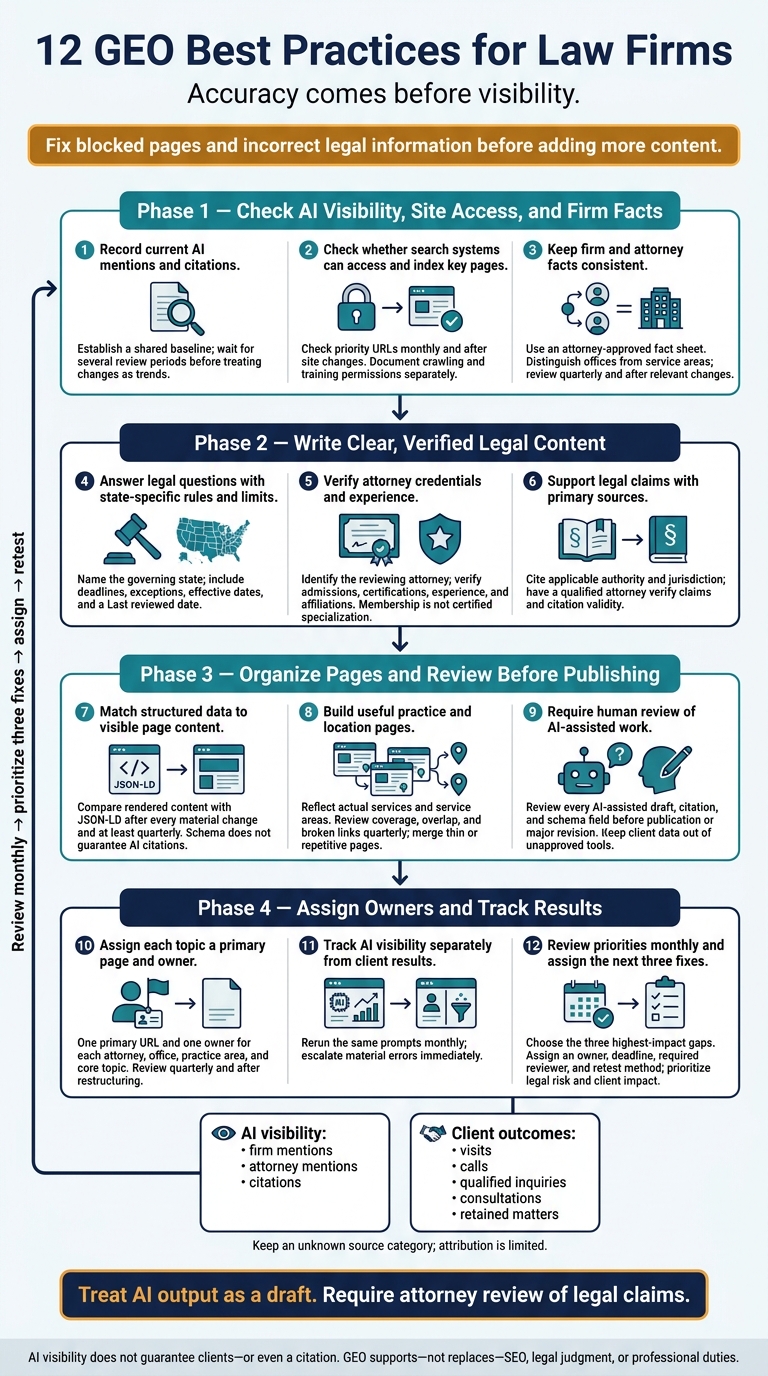
12 GEO Best Practices for Law Firms
Rank Your Law Firm On Google Maps with this Strategy | Part 3
sbb-itb-7e4986a
Check AI Visibility, Site Access, and Firm Facts
Start with site access and accurate firm information before refining content for AI search.
1. Record Your AI Search Baseline
Have marketing and intake leads use a shared workbook to track priority practice areas, locations, jurisdictions, and client questions. For each prompt, record the date, platform and mode, firm and attorney mentions, cited URLs, inaccuracies, and screenshots. Keep new prompts in a separate tab.
Wait for several review periods before treating changes as trends. Track organic visits, form submissions, calls, consultations, signed clients, and retained matters separately from AI visibility.
2. Check Page Crawling and Indexing
AI systems need access to a page to cite it. Have the web administrator check priority practice, location, attorney, and contact URLs monthly and after site changes. Check status codes, HTTPS, redirects, canonicals, noindex, robots.txt, sitemap inclusion, indexing, internal links, rendered text, mobile parity, speed, and hosting or CDN blocks.
Crawling and training permissions are separate. Document each instead of applying blanket crawler rules. Google’s guidance says pages must already be indexed and eligible for ordinary Search snippets to appear in AI Overviews and AI Mode. No special AI-only markup, dedicated schema, or llms.txt file is required.
3. Keep Firm and Attorney Facts Consistent
Once you’ve checked access, make sure firm facts match everywhere they appear. Maintain an attorney-approved fact sheet covering the firm’s legal name, contact details, offices, service areas, attorney names, credentials, bar admissions, jurisdictions, and services. Keep offices separate from service areas. Require attorney approval for specialization claims, case descriptions, awards, and results.
Check those facts against attorney bios, Google Business Profiles, state bar records, directories, social profiles, press releases, court publications, and professional organizations. Record each source, verification date, disputed field, and correction status.
Fix misleading credentials, jurisdiction claims, or office information right away. Review the facts quarterly and after departures, openings, closures, bar changes, mergers, rebrands, or practice-area changes.
Write Clear, Verified Legal Content
4. Give Direct, State-Specific Answers
Once access and fact checks are complete, sharpen each legal page’s substance as AI changes legal marketing. Start with a plain-English answer that names the governing state so readers and AI search systems can readily cite it. Put deadlines, notice rules, exceptions, and next steps directly after the rule. Include the law’s effective date and explain whether an amendment applies to earlier events. Readers and AI summaries should encounter the rule and its key limits right away.
Before publication - and again after legal changes - have the content lead check clarity and a qualified attorney verify the rule and its limits. Display a Last reviewed date. Explain that the page offers general information, not advice about the reader’s case, and provide a way to get fact-specific counsel. A disclaimer cannot fix a misleading answer.
5. Verify Attorney Credentials and Experience
Show readers and AI systems who reviewed the content. Name each legal page’s reviewing attorney and link to their biography. Publish only verified admissions, education, certifications, relevant experience, and affiliations. Separate total years in practice from years spent handling a particular claim type. Likewise, make clear that membership is not the same as certified specialization. Check claim-specific statements about admissions, certifications, experience, and affiliations against source records and the attorney’s bio.
Check what each credential means. California Formal Opinion 2019-199 warns against advertising credentials without legitimate, objective criteria or peer review. Confirm that any credential has objective, documented criteria. Keep records supporting experience and past-result claims, and remove unsupported superlatives and language that sets expectations about results.
6. Check Legal Claims Against Primary Sources
After checking credentials, tie each legal claim to primary authority. Support material claims with statutes, regulations, cases, rules, or official agency materials so AI systems can quote legal content backed by sources. Name the jurisdiction, cite the provision, and note effective dates. Distinguish binding authority from guidance. Have a qualified attorney check every claim, including whether cited cases remain valid.
Check deadlines, eligibility rules, and damages limits first. Remove outdated statements, citations that cannot be verified, and outcome guarantees. Keep a source log that records the claim, authority, reviewer, approval, and next review date.
Organize Pages and Review Before Publishing
7. Match Structured Data to Page Content
Once you’ve verified the content, set up each page so users and search systems get the same information.
Use schema types such as LegalService, Attorney, Organization, LocalBusiness, PostalAddress, ContactPoint, BreadcrumbList, Article, or FAQPage to support verified page copy. Schema must match the visible content. It does not guarantee AI citations.
Have the web administrator compare the rendered page with its JSON-LD after every material change and at least quarterly. Validate the syntax, check eligibility using Google’s validation tools, and review Search Console warnings. Remove duplicate, conflicting, or outdated markup. Log the affected URLs, validation results, and corrections.
8. Create Useful Practice and Location Pages
Build pages around actual services and service areas - not keyword swaps. Explain who the firm helps, the jurisdiction, the process, local limits, and how intake works. Clearly distinguish staffed offices from remote service areas.
Review coverage, overlapping content, and broken links quarterly. Merge thin or repetitive pages rather than keeping pages that repeat the same information.
9. Require Human Review of AI-Assisted Content
Once the page structure is set, require a final human review before publication.
Before publishing or making a major revision, have a human review every AI-assisted draft, citation, and schema field. The content lead must approve names, dates, titles, descriptions, alt text, links, and schema. Remove fabricated sources and unsupported conclusions. Treat AI output as a draft, not finished work. This human-in-the-loop approach is also critical when using AI tools for legal ad campaigns to ensure compliance and ROI.
ABA Formal Opinion 512 emphasizes lawyers’ duties of competence, confidentiality, candor, supervision, and advancing only meritorious claims when using generative AI.
Save draft versions, sources, requested corrections, reviewer names, the approval date, and the publication date. Keep client data out of unapproved tools. Before using representation-related information, review security, retention, access, and training rules.
Assign Owners and Track Results
10. Assign a Primary Page and Owner for Each Topic
Once a page is approved, assign ownership to keep it current. Give each attorney, office, practice area, and core topic one primary URL and one owner. Keep a register that records the primary URL, jurisdiction, reviewing attorney, publisher, last review date, next review date, and escalation contact. Link supporting pages to the primary URL with consistent terms.
The content lead and web administrator should review ownership, duplicate pages, visible page text, crawler controls, and publishing settings quarterly and after restructuring. Use redirects or canonical settings where appropriate, and stick to standard crawl, index, redirect, and schema rules.
11. Measure AI Visibility and Client Outcomes Separately
With ownership in place, track traditional vs AI-powered legal marketing visibility and intake on a fixed schedule. Rerun the same prompts monthly, logging the prompt, platform, date, response, cited URL, accuracy, reviewer, fix, and retest date. Send material errors to the reviewing attorney and marketing lead immediately.
Marketing and intake should report firm mentions, attorney mentions, and citations separately from client outcomes: visits, calls, qualified inquiries, consultations, and retained matters. Keep an “unknown source” category because missing referrals and multiple touchpoints limit attribution. Follow firm privacy policies, and leave confidential matter details out of testing logs.
12. Review GEO Priorities Each Month
Use the results to set priorities for the next month. Each month, the marketing lead, reviewing attorney, and web administrator should choose the three highest-impact gaps, with input from intake. Assign each gap an owner, deadline, required reviewer, and retest method.
Address legal risk and client impact first. At the next meeting, review accuracy, visibility, qualified inquiries, and retained matters separately.
Conclusion: Fix Access and Accuracy Gaps First
Complete the checklist before expanding content. Then fix blocked pages and misleading facts first. Require human review before publishing AI-assisted content.
For each unresolved issue, log the page URL, owner, deadline, verification source, and follow-up status. Review the log monthly and retest each fix before closing the issue.
GEO should support - not replace - SEO, legal judgment, or professional duties. In regular reporting, track mentions and citations separately from qualified inquiries and retained matters. Higher visibility does not guarantee better cases.
FAQs
How does GEO differ from SEO for law firms?
Generative engine optimization (GEO) shifts the focus from ranking in search results to being cited in AI-generated responses. SEO uses keywords, meta tags, and backlinks to bring traffic to your website. GEO focuses on structured, conversational content that AI models can easily extract and recommend.
Giupedi AI Legal Marketing Platform helps law firms keep pace with these AI-driven search trends through tools designed to improve visibility and engagement.
How long does it take to see GEO results?
You may see early GEO visibility within weeks. But more meaningful results usually take weeks to months, as AI platforms work your optimized content into their responses and begin citing it reliably.
What should we do if AI misstates our firm’s information?
Keep human oversight at the center of your AI reviews to check accuracy and compliance with ethical rules. Use the Giupedi AI Legal Marketing Platform to review how AI describes your services, locations, and practice areas. Then manually check and update your content, structured data, and schema markup to correct inaccuracies.
Verify legal claims, statutes, and attorney credentials against primary sources. Human judgment remains key to maintaining professional standards and meeting regulatory requirements in legal marketing.